Solar Panel Setup Guide
Solar PV glossary
Plain-English definitions of the solar panel, inverter, battery, tariff and paperwork terms you will meet in UK quotes and guides.
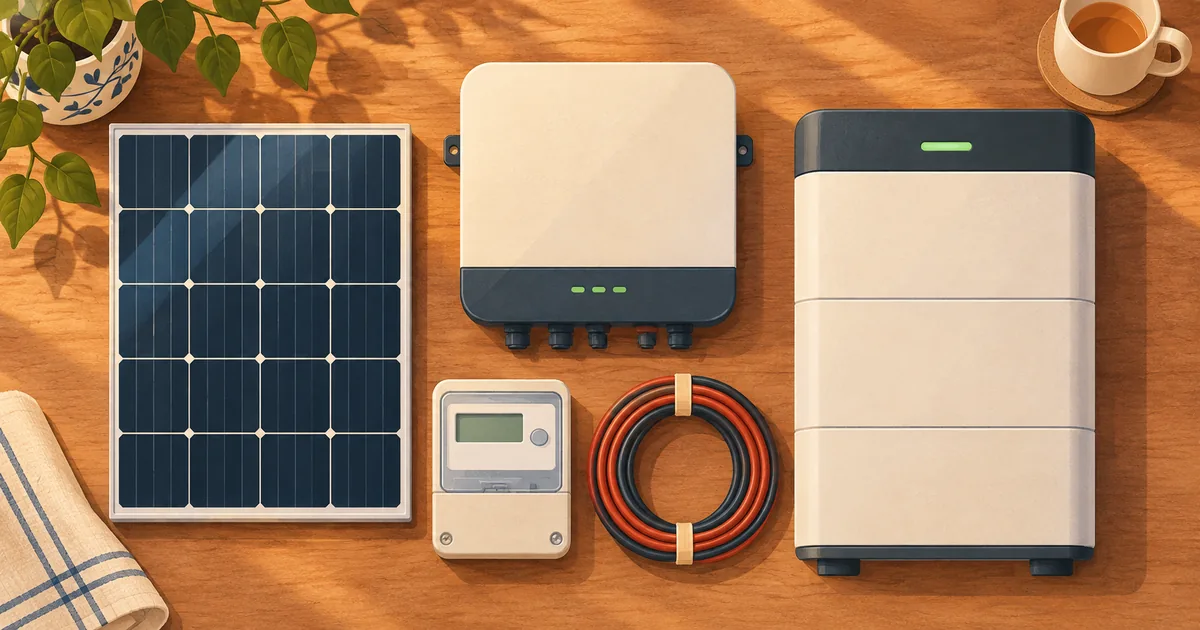
Short definitions of the terms used across this site. Each links to the guide where the idea matters most.
A
AC coupling
A way of adding a battery that connects on the AC side of the home's wiring, through its own inverter, alongside an existing solar inverter. It is a common way to add a battery later.
B
Back contact (BC)
A panel cell design that moves the electrical contacts to the back of the cell, leaving the front unobstructed. Some current residential modules use it. See solar panel brands.
BS 7671
The IET Wiring Regulations, the UK standard for electrical installations in buildings. Solar and battery wiring is expected to comply with it.
C
Competent Person Scheme
A government-authorised scheme that lets registered installers certify that their own work meets building regulations, without a separate building control application. See building regulations.
CT clamp
A current transformer clipped around a cable to measure the electricity flowing through it. Inverters, batteries and home energy monitors use CT clamps to see import and export.
D
DC coupling
A battery connected on the DC side, sharing a hybrid inverter with the panels, so that solar energy can charge the battery before it is converted to AC.
Degradation
The slow loss of a panel's output with age. Makers state it in the performance warranty, for example a maximum loss in the first year and a smaller annual loss after that. See how long panels last.
DNO
Distribution network operator: the company that runs the local electricity network in your area. It must be told about grid-connected generation through G98 or G99.
E
Export MPAN
A meter point administration number for the electricity you send to the grid. Ofgem's SEG guidance lists an export MPAN among the things an applicant needs.
G
G98
The engineering recommendation for small generators of up to 16 amps per phase, which is 3.68 kW on a single-phase supply. The DNO is notified after commissioning.
G99
The engineering recommendation for generators above the G98 limit. It needs an application to the DNO, and your installer usually handles it.
H
HIES
Home Insulation and Energy Systems: a consumer code approved by the Chartered Trading Standards Institute, offering deposit protection, insurance-backed guarantees and dispute resolution. See choosing an installer.
Hybrid inverter
An inverter that handles both solar panels and a DC battery. See inverter types.
I
Inverter
The box that converts the panels' DC electricity into AC electricity for the home. The Energy Saving Trust says it typically needs replacing after around 12 years.
K
Kk factor
The figure in the MCS standard MIS 3002 that turns kWp into estimated annual kWh for a postcode zone, roof pitch and orientation. MIS 3002 says it is drawn from PVGIS data multiplied by 0.8.
kWh
Kilowatt hour: a unit of energy, the one on your electricity bill. One kW sustained for one hour is one kWh.
kWp
Kilowatt peak: the combined rated power of the panels under standard test conditions. It is the usual way to describe system size.
L
LFP (lithium iron phosphate)
A lithium battery chemistry, also written LiFePO4, that many home batteries use. See solar batteries.
M
MCS
The Microgeneration Certification Scheme, which describes itself as the UK's quality mark for small-scale renewable technologies. An MCS certificate is normally needed for export payments.
Microinverter
A small inverter fitted behind each panel, so that each panel works independently. This helps on shaded or multi-direction roofs.
MPPT
Maximum power point tracking: the circuit in an inverter that finds the best operating point for a string of panels. Two MPPT inputs let two roof faces work independently.
O
Optimiser
A module-level device that adjusts each panel's output before it reaches a string inverter. The Energy Saving Trust notes that optimisers do not add output on an unshaded roof.
P
Permitted development
Building work that is allowed without a full planning application, provided it meets set conditions. Rooftop solar on many houses is likely permitted development — check with your council if in doubt, and note that Scotland, Wales and Northern Ireland have their own rules. See planning permission.
Plug-in solar
Small solar devices that connect directly to a socket using the manufacturer-supplied standard plug. In Great Britain, compliant devices have been legal since 27 August 2026: the maximum rated AC output is 800 W, the official specification also caps apparent power at 800 VA and current at 3.5 A, and plug-in or integrated battery storage is outside scope. Extension cables and AC adaptors are banned. The specification permits one device per final circuit, but says the GB network rule restricts this to one per household unless and until G98 changes. See the official Interim Product Specification, version 2 (PDF) and our plug-in solar guide. Northern Ireland has separate connection rules.
Price cap
The Ofgem limit on standard variable energy unit rates and standing charges. From 1 October to 31 December 2026, the GB average electricity unit rate on Direct Debit is 26.32p per kWh (checked 15 November 2026).
PVGIS
The Photovoltaic Geographical Information System from the EU Joint Research Centre: a free model of solar output for any location. Our estimator uses its yields.
R
RECC
The Renewable Energy Consumer Code, approved by the Chartered Trading Standards Institute. It covers quotations, deposits, contracts, guarantees and after-sales service.
S
Self-consumption
The share of your solar generation that you use in your home rather than export. It is usually worth more than exporting, because it replaces electricity you would otherwise buy.
Shade factor (SF)
The MCS figure that reduces an output estimate for shading. It is 1.00 for a clear horizon and lower when there are obstructions.
Smart Export Guarantee (SEG)
The scheme, launched on 1 January 2020, under which larger electricity suppliers must offer a tariff above zero for exported electricity. See SEG rates compared.
Smart meter
A meter that records import and export in half-hourly intervals and sends readings to your supplier. SEG payments rely on export readings.
String inverter
A single inverter that takes power from one or more strings of panels wired in series. It is the most common type on simple, unshaded roofs.
T
Time-of-use tariff
An electricity tariff whose price changes by time of day. It matters when you are deciding whether a battery is worth it.
TOPCon
Tunnel oxide passivated contact: an n-type cell technology that many current panels use, including the Trina Vertex S+ and Canadian Solar TOPHiKu6.
TrustMark
The government-endorsed quality scheme for trades working in and around the home. Registered businesses have been vetted against its standards.
Z
Zero rate VAT
The 0% VAT rate on installing qualifying energy-saving materials, including solar panels and batteries, in homes until 31 March 2027, according to HMRC's VAT Notice 708/6. This is general information, not financial or tax advice. Rules change, so check GOV.UK or speak to a qualified adviser.
Sources
Opened and checked on 15 November 2026.
- https://mcscertified.com/wp-content/uploads/2026/03/MIS-3002_Solar-PV-Systems-V6.0-Final.pdf
- https://www.ofgem.gov.uk/environmental-and-social-schemes/smart-export-guarantee-seg
- https://www.ofgem.gov.uk/sites/default/files/docs/2020/02/seg_generator_guidance_-_final_for_publication.pdf
- https://www.ofgem.gov.uk/your-energy-supply/your-energy-bill/energy-price-cap-unit-rates-and-standing-charges
- https://www.enwl.co.uk/get-connected/apply-for-a-new-connection/generation-and-storage/micro-generation-and-storage-connections/
- https://www.gov.uk/guidance/vat-on-energy-saving-materials-and-heating-equipment-notice-7086
- https://www.planningportal.co.uk/permission/common-projects/solar-panels/planning-permission-solar-equipment-mounted-on-a-house-or-a-block-of-flats-or-on-a-building/
- https://www.legislation.gov.uk/uksi/2026/848/made
- https://assets.publishing.service.gov.uk/media/6a60a03c47af652afa0c89f5/plug-in-solar-final-_interim-product-specification.pdf
- https://joint-research-centre.ec.europa.eu/photovoltaic-geographical-information-system-pvgis_en
- https://www.recc.org.uk/
- https://hies.org.uk/
- https://www.trustmark.org.uk/
- https://mcscertified.com/
- https://energysavingtrust.org.uk/advice/solar-panels/