Guides · Costs and savings
Solar panels vs a heat pump: which to spend on first
A decision framework for UK homeowners choosing between solar PV and an air source heat pump, using official grant, cost and tariff sources.
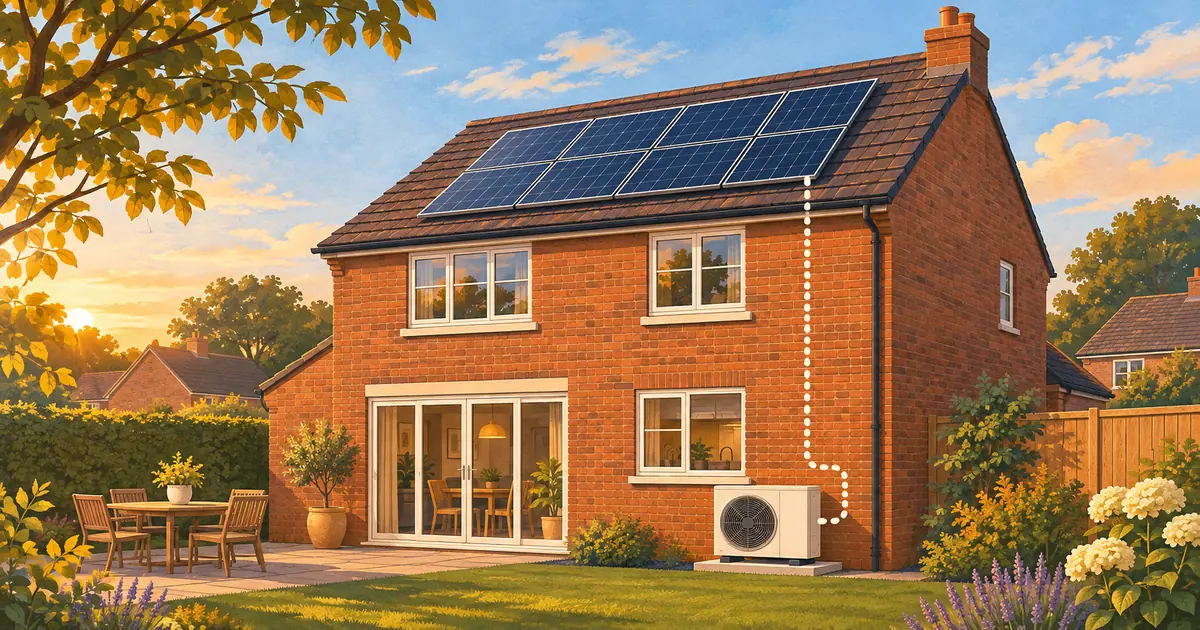
There is no single right order. Solar panels cut the cost of the electricity you already buy; a heat pump replaces the way you heat your home and hot water. If your boiler is working and your main aim is a lower electricity bill, solar usually comes first. If your boiler is near the end of its life, or you heat with oil or LPG, a heat pump with a government grant may be the bigger win. Many households end up with both, and the order matters because a heat pump changes how much electricity you use.
How the two compare at a glance
| Solar PV | Air source heat pump | |
|---|---|---|
| What it does | Generates electricity from daylight | Moves heat from outside air into your heating and hot water |
| Saves money by | Reducing electricity you buy, plus export payments | Replacing gas, oil, LPG or direct electric heating |
| Main grant in England and Wales | None for panels themselves | Boiler Upgrade Scheme: £7,500 towards an air source heat pump |
| Typical cost source | EST: around £7,600 for a 4.5 kWp system | Get quotes; we could not open the EST heat pump page on 15 November 2026 |
| Needs an MCS installer? | Yes, for export payments | Yes, for the grant |
| VAT on installation in homes | 0% until 31 March 2027 | 0% until 31 March 2027 |
Prices and grant amounts checked 15 November 2026.
The grant can change the order
The Boiler Upgrade Scheme is "open to people in England and Wales". GOV.UK lists "£7,500 towards an air source heat pump", "£7,500 towards a ground source heat pump" and "£5,000 towards a biomass boiler". It also says that "until March 2027, you can get an additional £1,500 towards an air source heat pump or ground source heat pump", but only for homes heated by oil or LPG without a mains gas connection. Check the current page before you plan, because grant rules change.
There is no equivalent national grant for buying home solar panels. Solar's financial support comes from the 0% VAT rate on installation and from Smart Export Guarantee payments for electricity you export.
GOV.UK says the zero rate on installing energy-saving materials in homes applies "from 1 May 2023 to 31 March 2027", and that "from 1 April 2027 onwards these will revert to the reduced rate of VAT of 5%". Both technologies are on the list. This is general information, not financial or tax advice. Rules change, so check GOV.UK or speak to a qualified adviser.
Questions that decide it
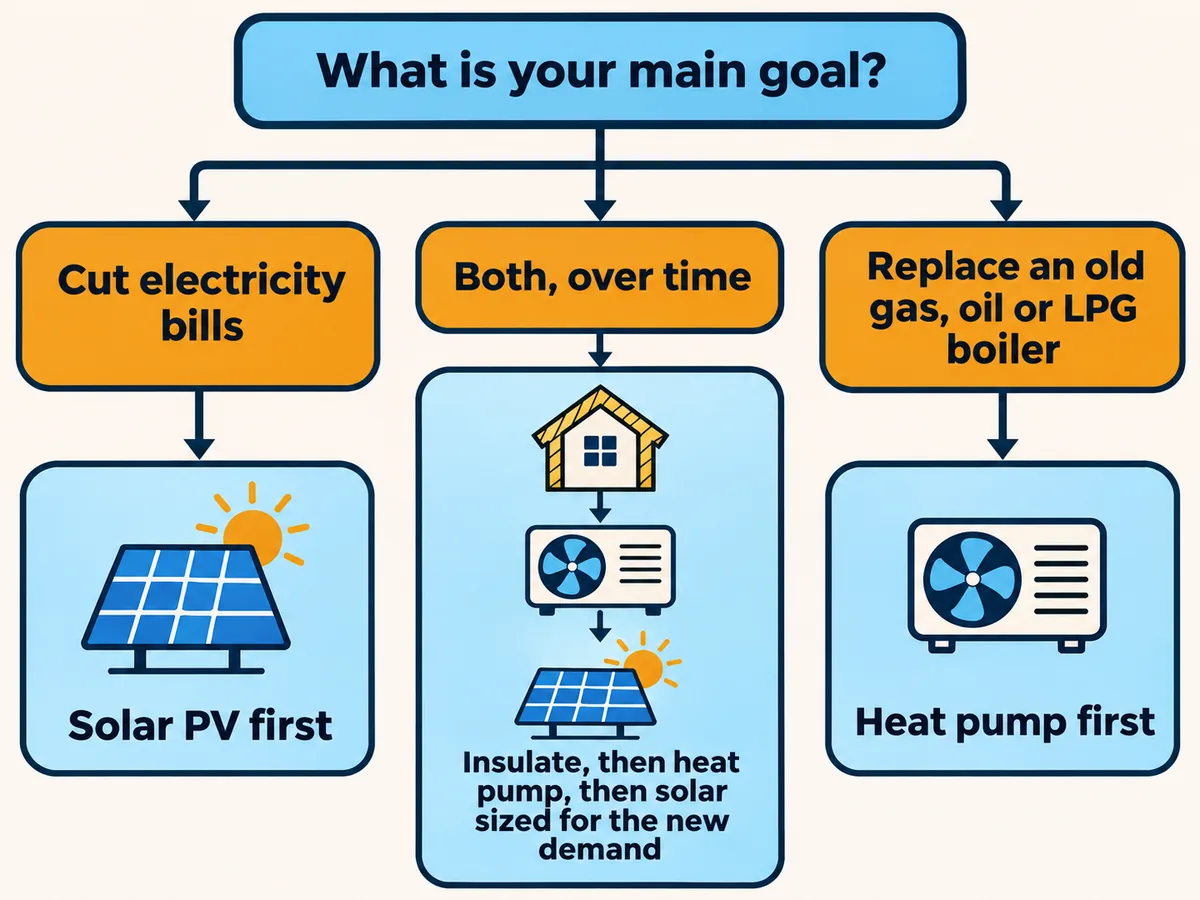
How old is your boiler?
Replacing a working boiler early is a cost you might avoid by waiting. A boiler that is failing is the natural moment to consider a heat pump, because you were going to spend money on heating anyway and the grant offsets part of it.
What fuel do you heat with?
The case for a heat pump is usually strongest when it replaces expensive heating fuel. The Ofgem price cap for 1 October to 31 December 2026 sets average Direct Debit unit rates of 26.32p per kWh for electricity and 7.97p per kWh for gas. A heat pump delivers several units of heat for each unit of electricity, so whether it beats gas depends on how efficiently it runs in your home. Ask installers for a written running-cost estimate based on a heat loss survey; we do not publish a typical figure because we could not verify one from an independent source on our check date.
How well insulated is the house?
Heat pumps work best with lower flow temperatures and a home that holds its heat. Insulation and draught-proofing first often reduce the size, and the cost, of the heat pump you need.
Is your roof suitable for solar?
An unshaded roof facing south, east or west works; EST does "not recommend installing panels on a north facing roof". If your roof is poor for solar, the decision is made for you.
Will you be home in the day?
Solar savings rise with daytime use. A heat pump running in daylight, or heating a hot water cylinder, can use more of your solar generation, which is one reason the two work well together.
Why the order matters if you want both
A heat pump adds electricity demand, mostly in autumn and winter when solar generation is lowest. If you install solar first, the installer sizes it for your current use. If you install a heat pump first, your higher annual electricity use may justify a larger solar system, subject to roof space and network limits.
A sensible sequence many households follow is:
- Fix the fabric: loft and wall insulation, draught-proofing.
- Install the heat pump when the boiler is due for replacement, using the grant if eligible.
- Add solar sized for the new, higher electricity demand.
If you install solar first, ask the installer to leave room in the design (inverter capacity, roof space, a cylinder location) for a heat pump later.
Ways solar can feed your heating
You do not need a heat pump to use solar for heat. A solar diverter can send surplus electricity to an immersion heater, and some households store it as heat instead of exporting it. Our sister site explains how a heat battery works with solar PV, which is worth reading if your export rate is low.
Costs to compare fairly
When you line up quotes, compare like with like:
- Solar: system size in kWp, generation estimate, panel and inverter models, scaffolding, any battery. Government Solar PV cost data puts the 2025/26 median for 0 to 4 kW installations at about £1,780 per kW on its long-running basis (checked 15 November 2026).
- Heat pump: heat loss survey, unit size, cylinder, radiator changes, controls, the grant deduction and the installer's running-cost estimate.
Both should come from installers certified by MCS, which says certification "is also a requirement for accessing many UK government incentives". Use the MCS installer search to find firms that do one or both.
Next steps
- Check whether solar is worth it for your roof.
- See current solar cost bands.
- Run your own numbers in the sizing estimator, raising annual use if a heat pump is planned.
- Read how to choose an installer.
Sources
Opened and checked on 15 November 2026.
- https://www.gov.uk/apply-boiler-upgrade-scheme
- https://www.gov.uk/apply-boiler-upgrade-scheme/what-you-can-get
- https://energysavingtrust.org.uk/advice/solar-panels/
- https://www.gov.uk/government/statistics/solar-pv-cost-data
- https://www.ofgem.gov.uk/your-energy-supply/your-energy-bill/energy-price-cap-unit-rates-and-standing-charges
- https://www.gov.uk/guidance/vat-on-energy-saving-materials-and-heating-equipment-notice-7086
- https://mcscertified.com/consumers/why-mcs-certification-matters/
- https://mcscertified.com/find-an-installer/