Guides · Panels, inverters and batteries
Best solar inverters UK: string, hybrid, microinverters and optimisers compared
Solar inverter types explained and compared using makers' published specs: string, hybrid, microinverters and optimisers, with efficiency, MPPTs and warranties.
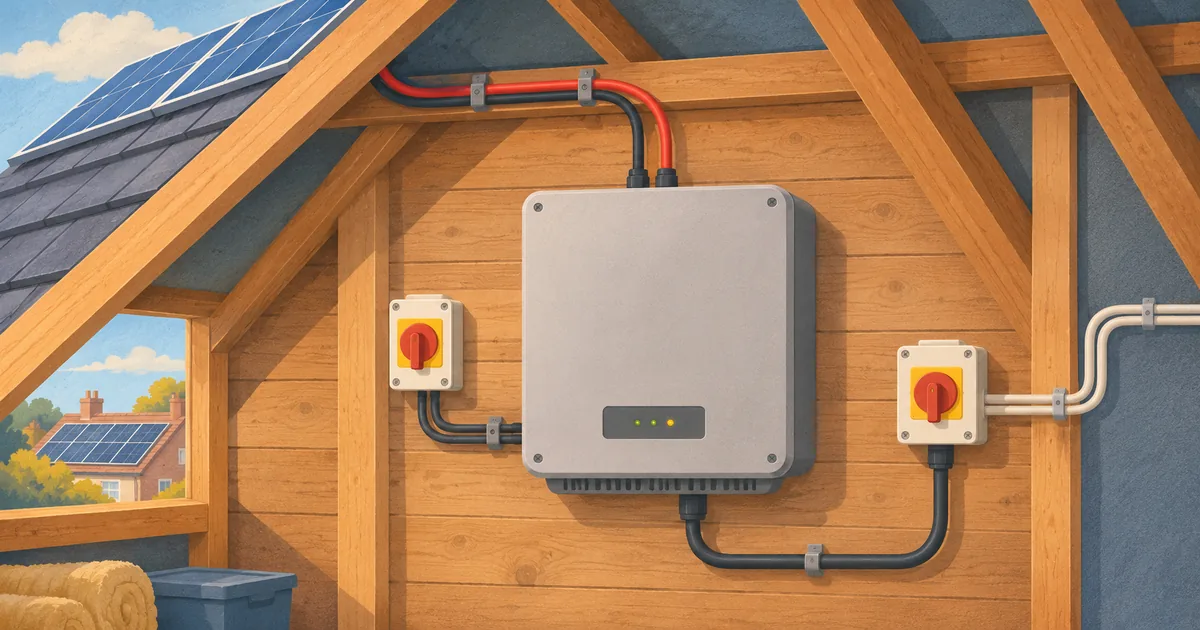
The best solar inverter is the type that suits your roof and your plans for a battery. A string inverter is the simple, common choice for an unshaded roof facing one way. A hybrid inverter adds a battery connection. Microinverters or optimisers help where panels face different ways or some are shaded. Within each type, the makers' published efficiency figures are close, so warranty, battery compatibility and installer support often matter more.
We haven't tested these products. This comparison is based on makers' published specifications and manuals, retailer listings and owner reviews (checked 15 November 2026).
The four types
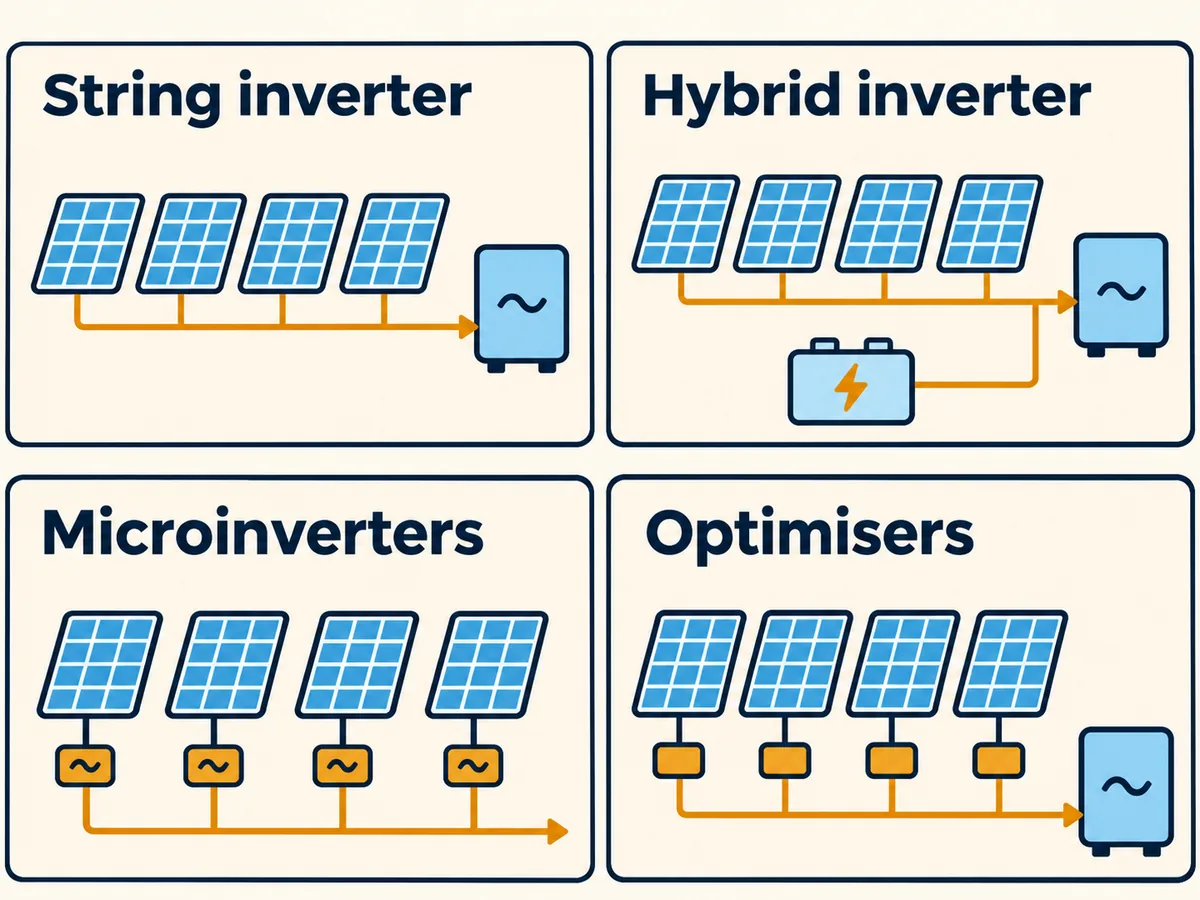
- String inverter. Panels are wired in series into one or two strings, each into a maximum power point tracker (MPPT) on a single wall-mounted inverter. The weak point is that a shaded panel can drag down its whole string.
- Hybrid inverter. A string inverter that also charges and discharges a battery (DC-coupled). Useful if you want a battery now or later.
- Microinverters. A small inverter behind each panel converts to AC on the roof, so each panel works independently.
- Optimisers. A small DC device behind each panel tracks that panel's best operating point, then feeds a central inverter.
The Energy Saving Trust's solar advice explains the trade-off for optimisers: "if one panel is shaded, it doesn't impact how much electricity the other panels can generate. If your roof doesn't have shading, optimisers won't help you generate more electricity." The same reasoning applies to microinverters.
String inverters compared
| Model | Rated AC output | Max / European efficiency | MPPTs | Warranty (as published) |
|---|---|---|---|---|
| SMA Sunny Boy 3.0–6.0 | 3.0, 3.68, 4.0, 5.0, 6.0 kW | 97.0% / 96.4–96.6% | 2 | 5 years; 10 years free with registration; 15-year option |
| Fronius Primo GEN24 4.6 (UK page) | 4.6 kW | 97.6% / 97.2% | 2 | Not stated on the page we opened |
| Solis S6-GR1P 2.5–6KK-S_Global.pdf) (global datasheet) | 2.5–6 kW | 97.3–97.7% / 96.5–97.1% | 2 | Not stated on the datasheet |
The Fronius page mentions battery connection for its backup features but names no compatible battery, so check with an installer if storage matters to you.
Hybrid inverters compared
| Model | Rated AC output | Max / European efficiency | MPPTs | Battery side | Warranty |
|---|---|---|---|---|---|
| GivEnergy Hybrid Gen 3 (low voltage) | 5.0 kW (3.6 kW backup) | 97.6% / 97% | 2 | 51.2 V LiFePO4; 3.3 kW charge, 3.6 kW discharge | 12 years |
| Fox ESS H1-G2 | 2.5–6 kW | European 95.26–96.33% | Not readable on the datasheet we opened | LFP | Not stated on the datasheet |
| Solis S6-EH1P 3–6K-LK-L-EU_GBR.pdf) (GB datasheet) | 3–6 kW | Over 97.9% / over 97.2% | 2 | 40–58 V low voltage; up to 6 kW | Not stated on the datasheet |
Microinverters and optimisers
| Product | Key published figures | Warranty |
|---|---|---|
| Enphase IQ8MC / IQ8AC / IQ8HC (UK datasheet, March 2026) | 325 / 360 / 380 W rated; IQ8MC 97.5% peak, 96.7% weighted; one per panel | 25 years, requires an internet-connected IQ Gateway |
| Tigo TS4-A-O optimiser | For panels up to 725 W; needs a Tigo CCA and TAP to communicate; works with "thousands of inverters", per the maker | "25-year warranty" (conditions not given on the page) |
We could not open SolarEdge's product pages (they returned an error), so SolarEdge optimisers and inverters are not in this comparison.
How to choose
- Look at your roof first. One unshaded roof face: a string or hybrid inverter is usually enough. Two or more faces, dormers, chimneys or trees shading part of the array: ask about optimisers or microinverters. Our guide to how many panels you need covers orientation and shading.
- Decide about a battery. If you want one now or soon, a hybrid inverter avoids a second inverter later. If you might add one in years to come, an AC-coupled battery can work alongside any inverter. See solar batteries compared.
- Match the size. Inverter output is often a little below the panels' peak kWp, because panels rarely reach their rating in UK conditions. Your installer sizes this.
- Check the grid limit. Network operator rules affect the size you can connect easily. Electricity North West says G98 covers installations "up to 16 amps per phase (Single phase systems up to 3.68kW...)" and "Anything larger will fall into a G99 application" (ENWL). That is why 3.68 kW inverters are common. See MCS, DNO and VAT paperwork.
- Read the warranty terms. Years vary from five to 25, and some depend on registration or an internet connection.
- Plan for replacement. The Energy Saving Trust says that if you have a solar inverter "you need to replace this after around 12 years". Microinverters sit on the roof, so a failed unit may need access equipment to replace.
Efficiency differences of a few tenths of a per cent are small next to the effect of orientation, shading and sizing. Do not let a datasheet decimal outweigh a sound installer recommendation and a long warranty.
Questions to ask your installer
- Which inverter type do you recommend for my roof, and why that one rather than optimisers or microinverters?
- What is the inverter's rated AC output, and how does it compare with the panels' total kWp?
- Will it connect under G98, or does my system need a G99 application first?
- Can it take a battery later, and which batteries is it compatible with?
- What warranty applies, does it depend on registration or an internet connection, and who handles a claim?
- Where will it be mounted? Lofts can get hot, so ask how the location fits the maker's installation manual.
- How will I monitor output, and what happens if the monitoring app or online account stops working?
Write the answers down and compare them across quotes. A clear, specific answer is a good sign; vague reassurance is not.
Inverters carry high DC voltages from the panels as well as mains voltage. Installation, isolation and replacement are jobs for an MCS-certified installer or qualified electrician following the maker's manual.
Next steps
- Choose storage to match: best solar batteries UK
- Compare panel specifications: best solar panel brands UK
- See what a full system costs: solar panel cost UK
Sources
Opened and checked on 15 November 2026.
- https://files.sma.de/downloads/SB30-60-DS-en-61.pdf
- https://www.fronius.com/en-gb/uk/solar-energy/installers-partners/technical-data/all-products/inverters/fronius-primo-gen24/fronius-primo-gen24-4-6
- https://www.solisinverters.com/uploads/file/Solis_datasheet_S6-GR1P(2,5-6)K-S_Global.pdf
- https://givenergy.com/hardware/hybrid-inverter-low-voltage-gen-3/
- https://www.fox-ess.com/Public/Uploads/uploadfile/files/20260612/ENH1G2DatasheetV2.220260609.pdf
- https://www.ginlong.com/uploads/file/Datasheet_S6-EH1P(3-6)K-L-EU_GBR.pdf
- https://enphase.com/en-gb/download/iq8mc-iq8ac-and-iq8hc-microinverters-data-sheet
- https://www.tigoenergy.com/product/ts4-a-o
- https://energysavingtrust.org.uk/advice/solar-panels/
- https://www.enwl.co.uk/get-connected/apply-for-a-new-connection/generation-and-storage/micro-generation-and-storage-connections/