Guides · Panels, inverters and batteries
Best solar panel brands UK: efficiency and warranties compared
Residential solar panels from Aiko, LONGi, Trina, REC, Canadian Solar and DMEGC compared on published efficiency, cell type and product and performance warranties.
The six residential panels compared here have published maximum efficiencies between 22.6% and 24.3%, so the brand matters less than people think. What separates them is the warranty: how many years the product itself is covered, and how much output the maker guarantees at the end of a 25 or 30-year performance warranty. This comparison uses each maker's datasheet, checked on 15 November 2026.
We haven't tested these products. This comparison is based on makers' published specifications and manuals, retailer listings and owner reviews (checked 15 November 2026).
Panels compared (makers' datasheets)
| Panel | Power range | Max efficiency | Cell type | Product warranty | Performance warranty |
|---|---|---|---|---|---|
| Aiko Neostar 2P54 | 450–485 W | 24.3% | ABC back contact | 25 years | 30 years; up to 1% loss in year 1, then up to 0.35% a year |
| LONGi Hi-MO X10 Explorer | 475–490 W | 24.0% | Back contact | 15 years | 30 years, 88.85% at year 30 |
| Trina Vertex S+ NEG9R.28 | 450–475 W | 23.8% | N-type TOPCon, dual glass | Up to 25 years | 30 years, 87.4% at year 30 |
| DMEGC Infinity RT | 445–465 W | 23.3% | N-type, bifacial | Not readable on the datasheet we opened | 30 years, 87.4% at year 30 |
| Canadian Solar TOPHiKu6 | 420–445 W | 22.8% | N-type TOPCon | 12 years | 30 years; up to 1% loss in year 1, then up to 0.4% a year |
| REC Alpha Pure-RX (Australian datasheet) | 440–470 W | 22.6% | Heterojunction (HJT) | 20 years; 25 years through REC-certified installers | 25 years, 92% at year 25 |
How to read this:
- Efficiency is how much of the sunlight hitting the panel becomes electricity under standard test conditions. Higher efficiency means more watts from the same area, which helps on a small roof. It does not change how much a watt of panel produces.
- Power range is the family of panel ratings. Your installer picks a specific wattage.
- Product warranty covers defects in the panel itself. It ranges from 12 to 25 years in this table.
- Performance warranty guarantees a minimum output after a number of years. Comparing the end figure (for example, 87.4% at 30 years against 92% at 25 years) is fairer than comparing the headline years alone.
- The REC figures come from an Australian datasheet; UK terms may differ, so ask your installer for the UK warranty document.
We could not open Maxeon's site (it failed with a certificate error), and the JA Solar and Jinko datasheets we found did not give readable residential figures, so those brands are not compared here.
What a performance warranty looks like
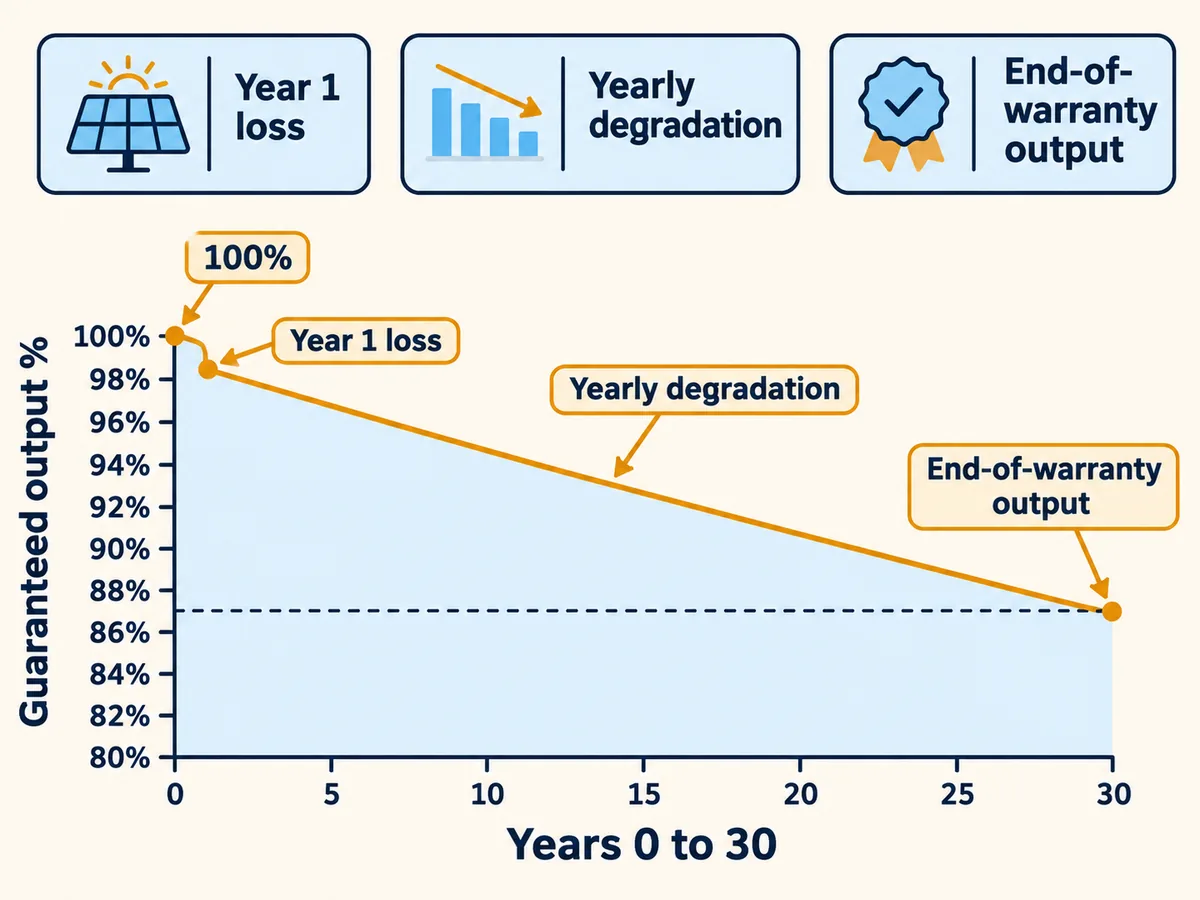
Makers guarantee a first-year loss and then a small yearly decline. Aiko's datasheet, for example, states no more than 1% in the first year and no more than 0.35% a year after that. A panel may outperform its warranty, but the warranty is the figure you can rely on. The Energy Saving Trust says panels "should last 25 years or more" (solar advice).
Does efficiency matter for you?
Work out whether you are short of roof space:
- Measure the usable roof area, leaving margins at the edges.
- Divide by the area of a panel. The Trina Vertex S+ datasheet gives 1,762 × 1,134 mm, about 2.0 m².
- Multiply the number of panels by the wattage.
If your roof comfortably fits the system your electricity use justifies, a slightly less efficient panel with a strong warranty can be the better buy. If space is tight, higher-efficiency panels let you fit more kWp. Our guide to how many solar panels you need and the sizing estimator walk through this.
Other things to check
- Appearance. All-black panels may suit a slate roof better; some makers sell them as a separate model.
- Certification for export payments. MCS says that for the Smart Export Guarantee your system should be "installed by an MCS certified installer using certified products" (MCS SEG page). Ask the installer to confirm the panel is certified.
- Who honours the warranty. A long warranty is only as useful as the company standing behind it in the UK. Ask the installer how a claim would be handled and who pays for removal and refitting.
- Inverter match. Panel voltage and current must suit the inverter or optimisers. That is the installer's design job; see solar inverters compared.
- Bifacial and dual-glass panels are built to collect some reflected light on the back. On a typical pitched roof, little light reaches the rear, so treat any bifacial gain as a bonus rather than a reason to choose.
A sensible shortlist approach
Rather than hunting for the single "best" brand, ask two or three MCS-certified installers which panels they fit and why. Then compare their suggestions on:
- product warranty years;
- end-of-warranty output and the year it applies;
- whether a certified UK warranty document is provided;
- price per kWp for the complete installed system.
A quote that is much cheaper because it uses an unfamiliar panel with a short product warranty may not be the bargain it looks.
Questions to ask about the panels in a quote
- What is the exact model and wattage, and can you send the datasheet?
- What are the product and performance warranty terms in the UK, and is the warranty registered in my name?
- If a panel fails, who pays for the scaffolding, removal and refitting?
- How many panels fit, and what margins have you left at the roof edges?
- Are the panels and inverter compatible, and does the design need optimisers for any shaded panels?
- Is the panel on the certified product list required for my SEG application?
Comparing the answers side by side is more useful than comparing brand names. The datasheets above show that a panel's efficiency and warranty can be checked in minutes; ask for the same documents for any panel you are offered.
Next steps
- See installed prices: solar panel cost UK
- Choose the inverter: best solar inverters UK
- Find an installer you can trust: choosing a solar installer
Sources
Opened and checked on 15 November 2026.
- https://aikosolar.com/en/products/neostar-2p54-mono-glass/
- https://static.longi.com/Hi_MO_X10_Explorer_LR_7_54_HVH_475_490_M_30_30_and_15_Frame_e909d07793.pdf
- https://www-cdn.trinasolar.com/wwwstorage/sites/7/eu-260224-datasheet-vertex-s-neg9r.28-en-2026-a-web-260224-datasheet-vertex-s-neg9r.28-en-2026-a-web.pdf
- https://www.recgroup.com/sites/default/files/2024-08/Web_DS_Alpha_Pure-RX_EN%20AU.pdf
- https://static.csisolar.com/wp-content/uploads/2022/09/24160043/CS-Datasheet-TOPHiKu6-TOPCon_CS6R-T_v1.8_EN.pdf
- https://www.dmegcsolar.com/upload/img/2025-07/686350ff059f6.pdf
- https://energysavingtrust.org.uk/advice/solar-panels/
- https://mcscertified.com/consumers/consumer-grants-incentives/smart-export-guarantee/