Guides · Panels, inverters and batteries
Best solar batteries UK: home batteries compared by published specs
Home batteries sold in the UK compared on makers' published capacity, power, chemistry, warranty and coupling, with dated cost bands and how to choose.
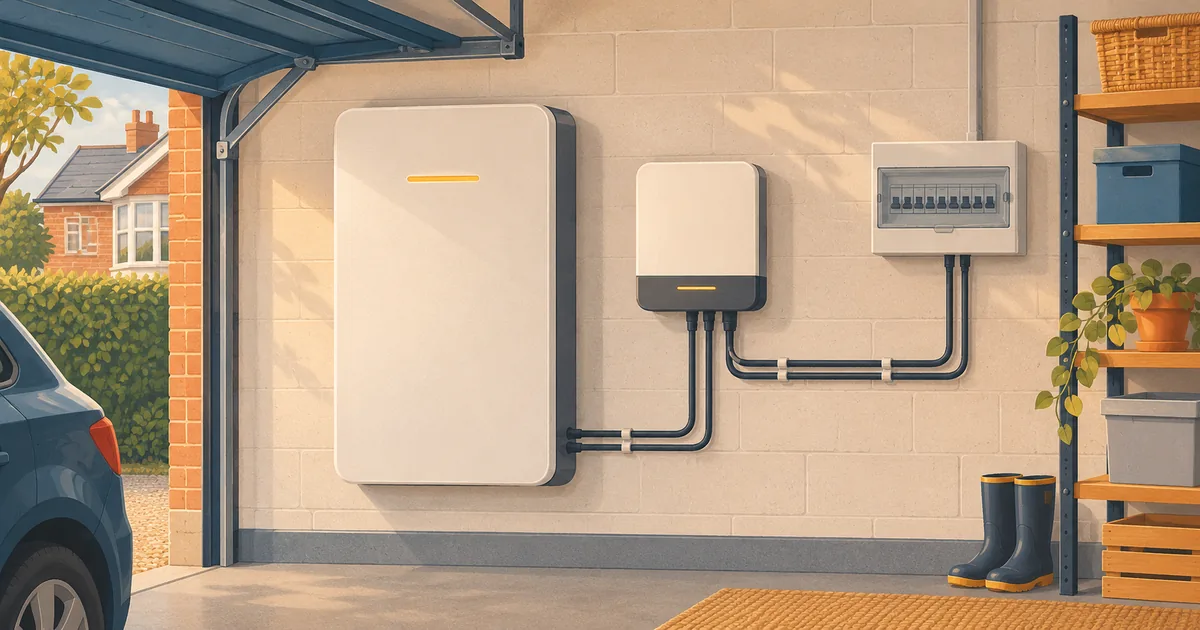
There is no single best solar battery: the right one depends on how much electricity you use after dark, the inverter you already have or plan to fit, and how much power you want at once. The makers' published specifications below, checked on 15 November 2026, show how much the options differ in usable capacity, output, warranty and how they connect.
We haven't tested these products. This comparison is based on makers' published specifications and manuals, retailer listings and owner reviews (checked 15 November 2026).
The Energy Saving Trust says a battery for a home solar system "can range from £1,500 to £10,000, but the cost for a 5kWh battery system is around £4,600" (battery storage advice, checked 15 November 2026). Its main solar panels page gives "around £5,000 to £8,000". Treat those as the market band; get installed prices from installers.
Black Friday and other sale prices can change at short notice through about 1 December. Treat any retailer checkout price as current only when you open it; do not assume a merchant's promotion ends on a particular date unless its own terms say so.
Batteries compared (makers' published figures)
| Battery | Capacity (as published) | Power | Chemistry | Warranty (as published) | Connection |
|---|---|---|---|---|---|
| Tesla Powerwall 3 (UK datasheet) | 13.5 kWh AC, expandable with up to three Expansion units | Up to 11.04 kW AC at 230 V; charges at 5 kW (8 kW with Expansions) | Not stated on the datasheet we opened | 10 years, conditional on a reliable internet connection | Built-in solar inverter, 3 MPPTs, 20 kW max PV |
| GivEnergy All in One 2 | Advertised as 13.5 kWh; design energy 15.9 kWh; up to two Expansion batteries | Discharge up to 12.6 kW, charge 6 kW | LiFePO4 | 15 years | AC-coupled; optional MPPT unit makes it hybrid |
| Fox ESS EP11 | 10.36 kWh nominal at 90% depth of discharge; up to four in parallel | 27 A max at 384 V nominal (no kW figure given) | LFP | Not stated on the datasheet | DC, pairs with Fox hybrid inverters |
| Huawei LUNA2000-S1 | 5 or 6.9 kWh modules; 5 to 20.7 kWh per stack | 3.5, 7 or 10.5 kW listed | LiFePO4 | Not on the specs page | DC, Huawei SUN2000 hybrid inverters |
| Enphase IQ Battery 5P | 5.0 kWh | Up to 3.84 kVA continuous | LFP (per the North America datasheet) | 15 years or 6,000 cycles | AC-coupled, built-in microinverters |
| myenergi libbi | Up to 5 kWh per module; 20 kWh max with four | 3.68 kW or 5 kW inverter, depending on system | Not stated | Battery 10 years; inverter and controller 5 years | Described as AC- and DC-coupled |
| Puredrive PureStorage II | 5 kWh battery | Set by the inverter, per the maker | LiFePO4 | 10,000 cycles (years not stated) | Not stated on the page we opened |
Notes on the table:
- Makers state capacity differently: "usable", "nominal" and "design" energy are not the same. Ask the installer for usable capacity in kWh at the start of life.
- The Enphase warranty figure comes from its UK store page; its chemistry and end-of-warranty capacity come from the North America datasheet, and the myenergi page we could open was the Netherlands English version. UK terms may differ.
- Several warranties carry conditions, such as an internet connection. Read the maker's UK warranty document before you buy.
AC-coupled or DC-coupled?
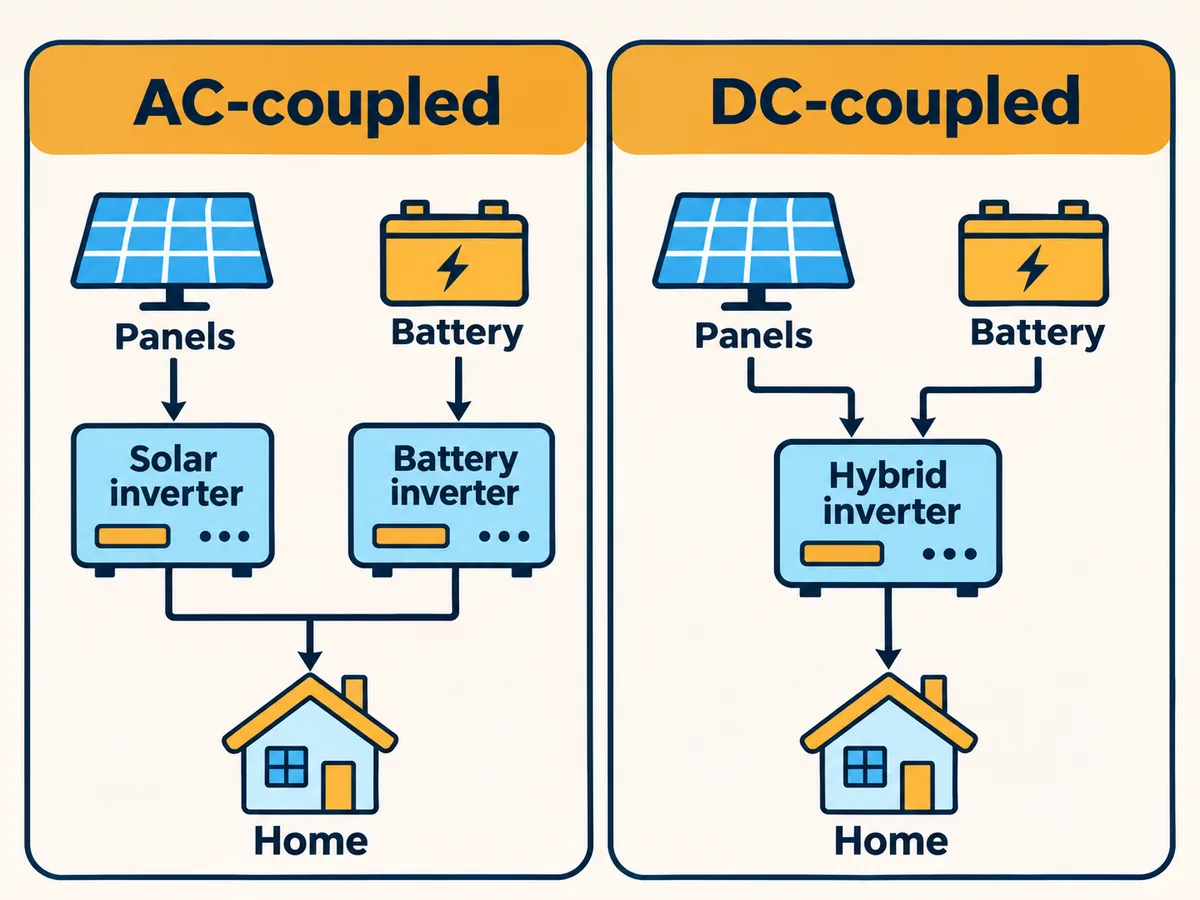
- AC-coupled batteries have their own inverter and connect on the household AC side. They suit adding storage to an existing solar system without replacing a working inverter. Enphase IQ Battery 5P and the GivEnergy All in One 2 are sold this way.
- DC-coupled batteries share a hybrid inverter with the panels. Solar energy goes into the battery without an extra conversion, and one inverter does both jobs. Fox ESS EP11 and Huawei LUNA2000 pair with their makers' hybrid inverters.
- All-in-one units, such as Powerwall 3, put the solar inverter inside the battery.
If you are installing panels and a battery together, a hybrid or all-in-one setup is common. If you already have panels, an AC-coupled battery avoids replacing the inverter. See solar inverters compared.
What to compare
- Usable capacity (kWh). Enough to cover your evening and overnight use, not more. The Energy Saving Trust says a typical home system "might be 10 kWh". Size it from your own data: our solar battery guide shows the method.
- Power (kW). This limits how many appliances the battery can run at once. A kettle, oven and shower together can exceed a small battery's output, and the shortfall comes from the grid.
- Chemistry. Most batteries above are lithium iron phosphate (LFP or LiFePO4). If you are curious about newer chemistries, our sister site explains sodium-ion home batteries in the UK.
- Warranty. Look for years, a cycle or throughput limit, and the capacity guaranteed at the end. Several makers above do not publish all three.
- Backup in a power cut. Not every battery powers the home during an outage. Ask whether it offers whole-home backup, a backup socket, or none.
- Expandability. Some systems add modules later; others need a second complete unit.
- Where it goes. Check the IP rating if it will be outside or in a garage, and follow the maker's installation manual on location and clearances.
The Energy Saving Trust gives a "typical lifespan of a battery" of "about 10 to 12 years", which is shorter than the 25 years or more it gives for panels. Factor in a replacement.
VAT and installation
Batteries installed in homes are zero-rated for VAT until 31 March 2027 under GOV.UK's VAT Notice 708/6, including a battery retrofitted to existing solar panels. Batteries bought without installation are standard-rated.
This is general information, not financial or tax advice. Rules change, so check GOV.UK or speak to a qualified adviser.
Home batteries connect to your electrical installation and, in most cases, need notifying to your network operator. Have one installed by an MCS-certified installer or qualified electrician, following the maker's manual.
Next steps
- Decide whether a battery adds up for you: is a solar battery worth it?
- Match a battery to an inverter: best solar inverters UK
- Budget the full system: solar panel cost UK
Sources
Opened and checked on 15 November 2026.
- https://energylibrary.tesla.com/docs/Public/EnergyStorage/Powerwall/3/Datasheet/en-uk/Powerwall-3-Datasheet-EN.pdf
- https://givenergy.com/hardware/all-in-one-2/
- https://www.fox-ess.com/Public/Uploads/uploadfile/files/Download/EN-EP11-Datasheet-V1.5-20251023.pdf
- https://solar.huawei.com/en/products/luna2000-7-14-21-s1/specs/
- https://enphase.com/en-gb/store/storage/iq-battery-5p-flexphase
- https://enphase.com/download/iq-battery-5p-data-sheet
- https://www.myenergi.com/nl/en/libbi/
- https://puredrive-energy.co.uk/faqs
- https://energysavingtrust.org.uk/advice/solar-panel-battery-storage/
- https://energysavingtrust.org.uk/advice/solar-panels/
- https://www.gov.uk/guidance/vat-on-energy-saving-materials-and-heating-equipment-notice-7086