Guides · Installers and scams
Choosing a solar installer and avoiding solar scams
How to check a UK solar installer's MCS certification and consumer code, compare quotes, use your cooling-off rights and spot cold-call scams.

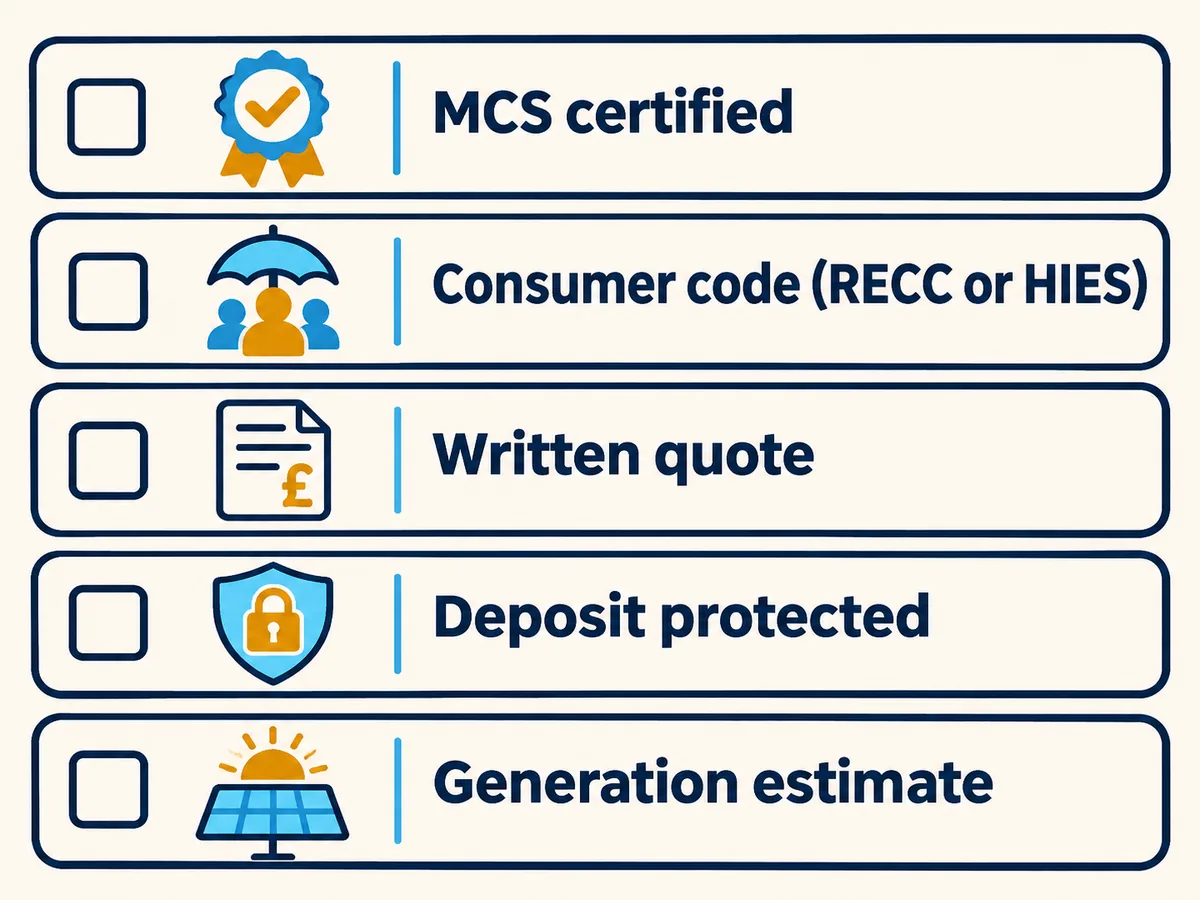
The safest way to buy home solar is to choose an installer who is MCS certified, belongs to a consumer code approved by the Chartered Trading Standards Institute (in solar, usually RECC or HIES), gives you a written quote with an MCS-method generation estimate, and protects your deposit. Be wary of anyone who contacts you out of the blue. This guide covers what each check means and how to verify it yourself.
Check 1: MCS certification
MCS certification is what lets your system qualify for export payments under the Smart Export Guarantee, and MCS says on why certification matters that it "is also a requirement for accessing many UK government incentives". Look the company up yourself on the MCS find an installer search, rather than relying on a logo on a van or a website. MCS warns on its Be Scam Aware page that "some installers can also pose as MCS certified even when they are not."
Check 2: a consumer code
MCS installers must belong to a consumer code. The two you are most likely to see for solar are:
- RECC (Renewable Energy Consumer Code). RECC's home page says it "is approved by the Chartered Trading Standards Institute as part of the Approved Code Scheme" and covers "quotations, deposits, contracts, guarantees and after-sales service". Its consumer support page tells customers to "check your installation paperwork for details of your insurance-backed workmanship warranty and deposit protection", and explains that disputes can go to an independent dispute resolution service.
- HIES (Home Insulation and Energy Systems). HIES says "all HIES Accredited Installers operate under a CTSI Approved Consumer Code", and lists deposit and stage payment protection, insurance-backed guarantees and alternative dispute resolution.
You may also see TrustMark, which describes itself as "the Government Endorsed Quality Scheme" for work in and around the home. It is useful extra reassurance but is not a substitute for MCS when it comes to export payments.
Check 3: what a good quote includes
Ask at least three installers for a written quote after a proper survey (in person or with detailed photos and measurements). A good quote should set out:
- System size in kWp, the number of panels, and the panel, inverter and any battery models.
- A generation estimate made with the MCS method. The MCS installation standard, MIS 3002, sets out the calculation (annual output = kWp × a postcode-zone and orientation factor × a shade factor) and requires installers to tell customers that the shading method "will yield results within 10% of the actual energy estimate stated for most systems". Treat any figure that is much higher than a comparable quote with caution.
- A self-consumption estimate, which MIS 3002 also requires, so you can see how much of the generation you are expected to use yourself.
- The total price including VAT (currently 0% for most home installations; see our paperwork guide), the deposit amount and the payment stages. This is general information, not financial or tax advice. Rules change, so check GOV.UK or speak to a qualified adviser.
- Scaffolding, bird proofing, any roof repairs and the grid notification spelled out, so you can compare like with like.
- Warranties: panel product and performance warranties, inverter and battery warranties, and the installer's workmanship warranty.
- Roof checks. The Planning Portal says the roof's ability to carry the load "will need to be checked and proven" (building regulations page). Ask who does this and what happens if strengthening is needed.
You can sanity-check the size and price against our solar panel cost guide and the sizing estimator.
Try the numbers for your own roof: the solar sizing and savings estimator turns roof area, orientation, region and electricity use into a kWp range, a generation estimate and an indicative payback range, with every default sourced.
Your right to cancel
If you sign a contract in your home rather than at the firm's premises, you usually get a cooling-off period. Citizens Advice says this applies where "you were approached by the business somewhere away from the business's premises and the service costs £42 or more" (threshold as stated on that page, checked 15 November 2026), and that "your cooling-off period begins the day after you enter a contract." RECC says that "in many cases, you have 14 days to cancel your contract without penalty". If you ask for work to start inside the cooling-off period, Citizens Advice explains the business can keep the cost of the service already provided.
Do not let anyone hurry you into waiving that right.
Solar scams and cold calls
Cold calling is common. In a Which? news article from August 2024, "more than a third of solar PV panel owners in our recent survey told us they have been cold called". The article lists the most common pitches, including:
- "health checks" on an existing system
- upgrades and extra panels
- buyback schemes
- replacing the inverter
- voltage optimisers
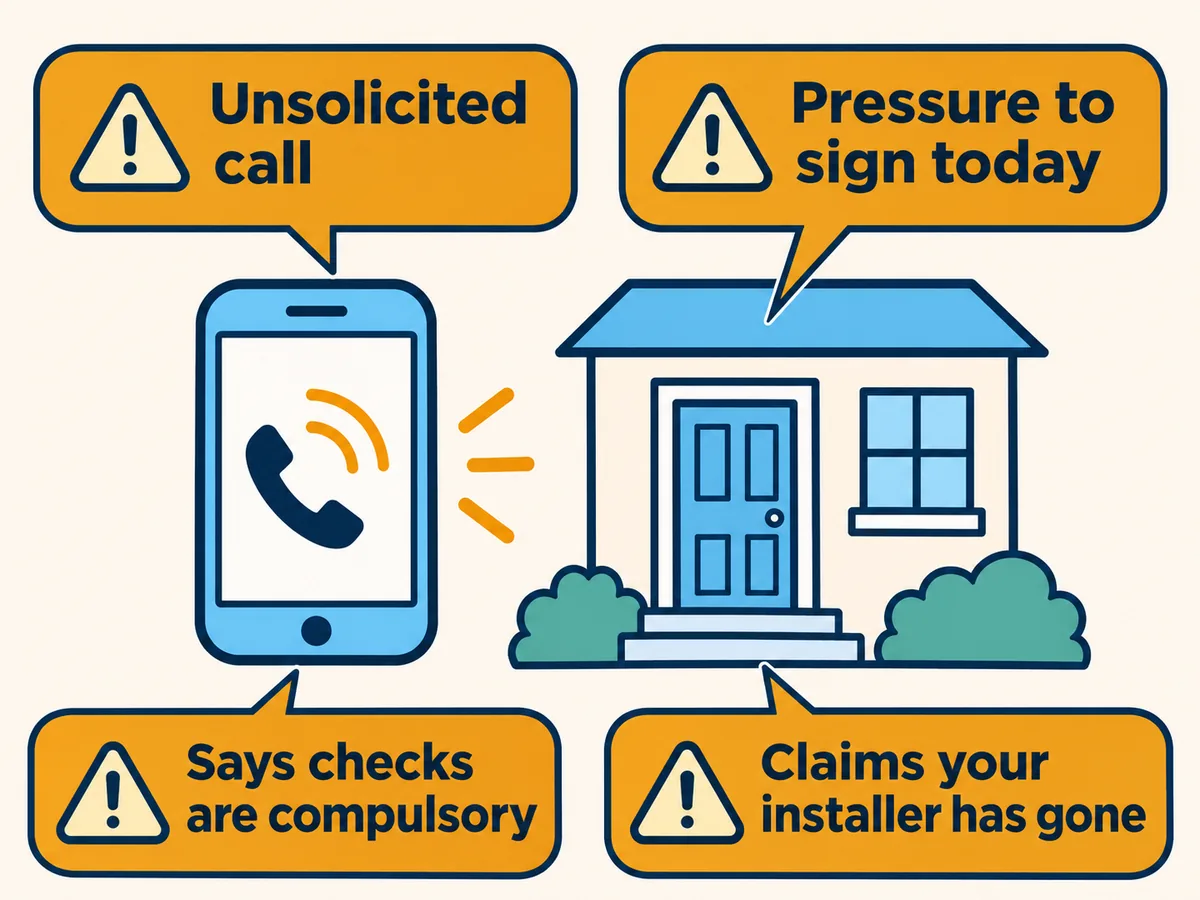
- false claims that your original installer has stopped trading
Which? also addresses the claim that annual checks are a legal requirement: "this is not true". Its advice is to "be cautious of anyone contacting you uninvited."
MCS is blunt about its own name being misused: "MCS will never cold call you" (Be Scam Aware). It points people to the Citizens Advice consumer service to report scams.
Warning signs
- The caller contacted you first, especially if they already seem to know you have solar.
- Pressure to sign today, or a "discount" that disappears tomorrow.
- A claim that a check, upgrade or new inverter is compulsory.
- Reluctance to give a full company name, address, MCS number or consumer code.
- A large deposit with no mention of deposit protection.
- Generation or savings figures far higher than other quotes for the same roof.
If you already have panels and someone says your installer has gone bust, check yourself: look the installer up on the MCS search, and check your paperwork for the insurance-backed warranty, which is meant to cover that situation.
Never let anyone on your roof or into your consumer unit just because they turned up. Solar systems carry DC voltage from the panels whenever there is daylight. Work on them is for qualified installers following the maker's instructions.
After the installation
Before you make the final payment, make sure you have the MCS certificate, the grid notification, the building regulations and electrical certificates, and the warranty documents. Our paperwork guide has a full checklist.
Next steps
- Get a feel for sensible sizes with how many solar panels you need.
- Compare prices with the solar panel cost guide.
- Read the short answer on whether a "free solar panels" offer is a scam.
- Look up MCS and RECC in the glossary.
Sources
Opened and checked on 15 November 2026.
- https://mcscertified.com/find-an-installer/
- https://mcscertified.com/consumers/why-mcs-certification-matters/
- https://mcscertified.com/consumers/be-scam-aware/
- https://mcscertified.com/wp-content/uploads/2026/03/MIS-3002_Solar-PV-Systems-V6.0-Final.pdf
- https://www.recc.org.uk/
- https://www.recc.org.uk/consumers/consumer-support/
- https://hies.org.uk/
- https://www.trustmark.org.uk/
- https://www.which.co.uk/news/article/beware-these-solar-panel-cold-calls-aH0fP6b22eOc
- https://www.citizensadvice.org.uk/consumer/changed-your-mind/cancelling-a-service-youve-arranged/
- https://www.planningportal.co.uk/permission/common-projects/solar-panels/building-regulations/