Guides · Costs and savings
Solar panel cost UK: what a home system costs in 2026
Dated installed-cost bands for UK home solar PV from the Energy Saving Trust, MCS and DESNZ, plus batteries, VAT and the running costs to budget for.
A typical UK home solar PV system costs roughly £6,400 to £8,000 installed for about 4 kWp, on government cost data checked on 15 November 2026. The Energy Saving Trust puts a typical 4.5 kWp system at around £7,600, and MCS says the average certified home installation in 2025 cost just over £7,000. A battery adds several thousand pounds more.
Those are averages. Your quote depends on roof size and access, the panels and inverter chosen, scaffolding, and whether you add a battery. This guide sets out the published figures, shows how to turn them into a band for your own system, and lists the costs that come later.
Black Friday and other sale prices can change at short notice through about 1 December. Treat any retailer checkout price as current only when you open it; do not assume a merchant's promotion ends on a particular date unless its own terms say so.
The headline figures (checked 15 November 2026)
| Source | What it says | Basis |
|---|---|---|
| Energy Saving Trust | "Generally, domestic solar panel systems are around 4.5 kWp and cost around £7,600" | Advice page last updated 1 October 2026 |
| MCS | Average certified home installation in 2025 "just over £7,000", around £500 less than 2024 | MCS Data Dashboard |
| DESNZ Solar PV cost data | 0–4 kW installations in 2025/26: median £1,780 per kW, mean £2,008 per kW (DNC basis); median £1,595 per kW on the newer TIC basis | 187,554 installations, updated 28 May 2026 |
The DESNZ figures are the most useful for working out your own band because they are per kilowatt. They also show prices falling: the 2024/25 median on the same basis was £1,884 per kW, and the department's commentary says the inflation-adjusted median for 0–4 kW systems fell by 9 per cent.
The two DESNZ series measure slightly different things. The DNC series is the long-running one and is comparable with earlier years; the TIC series is newer and labelled "Official Statistics in development". We use the TIC median as the low end of a band and the DNC mean as the high end, which is a wide but honest range.
Turning per-kW figures into a band for your roof
Multiply the size of system you are considering by the low and high figures:
| System size | Low (£1,595/kW) | High (£2,008/kW) |
|---|---|---|
| 3 kWp | about £4,800 | about £6,000 |
| 4 kWp | about £6,400 | about £8,000 |
| 4.5 kWp | about £7,200 | about £9,000 |
| 5 kWp | about £8,000 | about £10,000 |
These are rounded multiples of the DESNZ 2025/26 figures for 0–4 kW systems, so the 5 kWp row is an extrapolation. Larger systems often cost a little less per kW because fixed costs such as scaffolding and paperwork are spread over more panels, but check that against real quotes rather than assuming it.
Not sure what size fits? The Energy Saving Trust says a 4.5 kWp system "typically covers between 20 to 30m2 of roof surface area, typically using around 12 panels". Our guide to how many solar panels you need explains roof area, orientation and shading.
Try the numbers for your own roof: the solar sizing and savings estimator turns roof area, orientation, region and electricity use into a kWp range, a generation estimate and an indicative payback range, with every default sourced.
What a quote should include
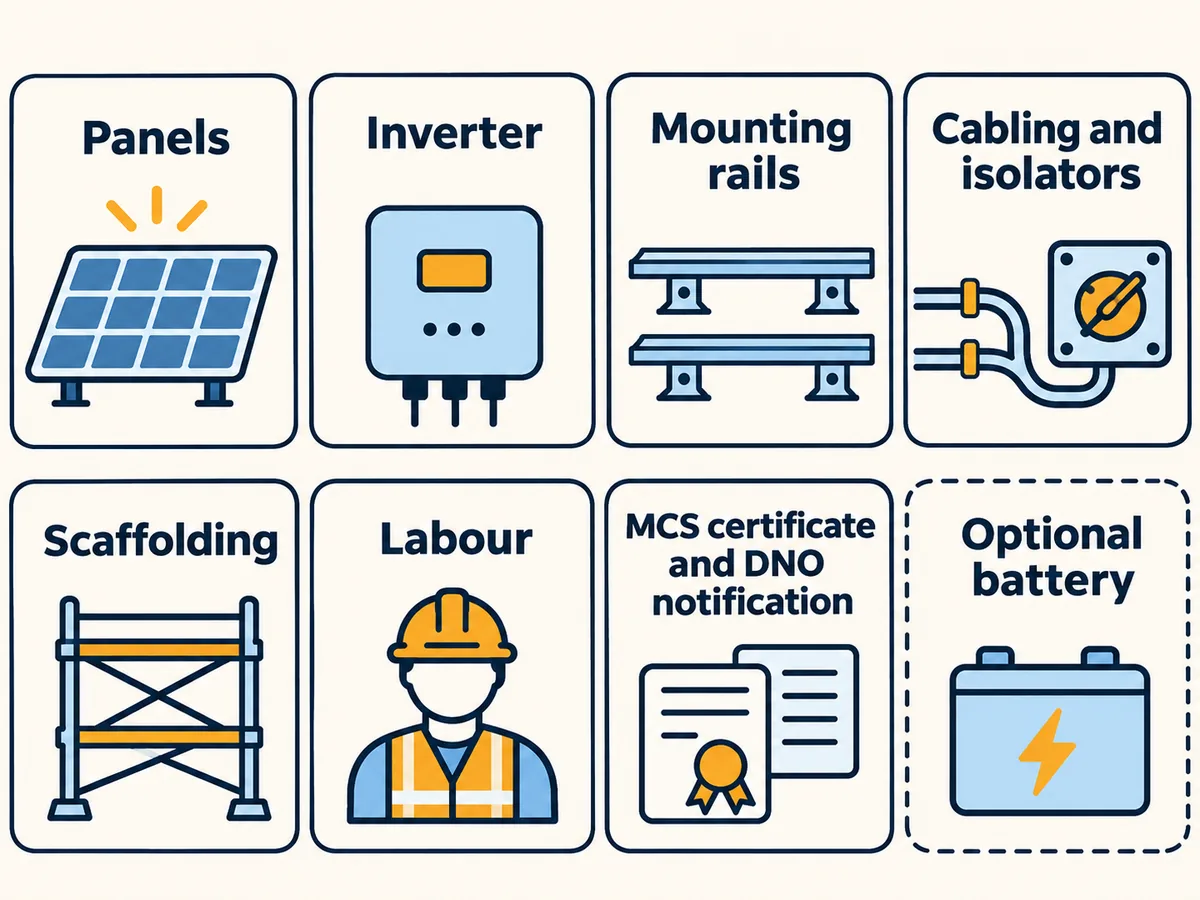
A complete quote from an installer should itemise, or at least clearly include:
- Panels and their mounting rails and roof hooks.
- Inverter (string, hybrid or microinverters) and any optimisers. See solar inverters compared.
- Cabling, isolators and the generation meter, plus any consumer unit work.
- Scaffolding or access equipment. Ask whether it is included and for how long.
- Labour, commissioning and paperwork: the MCS certificate and the notification or application to your network operator. Our guide to MCS, DNO and VAT paperwork covers what each is for.
- Roof checks. The Planning Portal says the ability of the existing roof to carry the load of the panels "will need to be checked and proven", and some strengthening work may be needed. That can add cost.
- Warranties: on panels, inverter and workmanship.
Compare quotes on the same basis: the same system size in kWp, the same type of inverter, and with or without a battery.
VAT on solar panels
Installation of solar panels in homes is zero-rated for VAT. GOV.UK's VAT Notice 708/6 says "A zero rate applies to the installation of certain specified energy-saving materials from 1 May 2023 to 31 March 2027", and that "From 1 April 2027 onwards these will revert to the reduced rate of VAT of 5%." Electrical storage batteries installed in homes have been included since 1 February 2024, including a battery retrofitted to an existing solar system.
The relief applies to installed materials. The same notice says that if materials are supplied without installation, the supply is standard-rated, so DIY kits bought online do not qualify.
This is general information, not financial or tax advice. Rules change, so check GOV.UK or speak to a qualified adviser.
Adding a battery
The Energy Saving Trust gives two ranges on its own pages. Its battery storage page says costs "can range from £1,500 to £10,000, but the cost for a 5kWh battery system is around £4,600", while its main solar page says battery storage "tends to cost around £5,000 to £8,000". The same battery page says "a typical home system might be 10 kWh" and that the "typical lifespan of a battery is about 10 to 12 years".
Fitting a battery at the same time as the panels can save a second visit, and a hybrid inverter can handle both. Whether a battery pays back for you depends on your usage pattern and tariff; our guide to whether a solar battery is worth it sets out the method, and solar batteries compared lists published specifications.
Costs that come later
Solar has low running costs, but budget for these:
- Inverter replacement. The Energy Saving Trust says that if you have a solar inverter "you need to replace this after around 12 years", and that most inverters have warranties of at least five years, often extendable to 15. It does not give a replacement price, so ask installers to quote one.
- Cleaning. In most cases rain keeps roof panels clean. If you pay for a professional clean, the Energy Saving Trust's cleaning guide says to expect "at least £60 to £100", more for large or hard-to-reach roofs.
- Bird proofing, if pigeons nest under the array. See solar panel maintenance, cleaning and bird proofing.
- Battery replacement, if you have one, at the end of its life.
The Energy Saving Trust says panels "should last 25 years or more", so the panels themselves usually outlast at least one inverter.
How to get a reliable price
- Find two or three installers through the MCS installer search. MCS certification is needed for the Smart Export Guarantee in practice; see SEG export rates compared.
- Ask each for a site survey, a written generation estimate using the MCS method, and an itemised quote.
- Check what the price includes: scaffolding, roof checks, bird proofing, the DNO notification and warranties.
- Compare price per kWp, not just the total.
- Be wary of pressure selling. Our guide to choosing a solar installer covers consumer codes, deposits and cold calling.
Next steps
- Turn a cost into a payback range: is solar worth it in the UK?
- See what you could be paid for exported electricity: SEG export rates compared
- Estimate your own system: the solar sizing and savings estimator
Sources
Opened and checked on 15 November 2026.
- https://energysavingtrust.org.uk/advice/solar-panels/
- https://mcscertified.com/consumers/technologies/solar-photovoltaic-pv/
- https://www.gov.uk/government/statistics/solar-pv-cost-data
- https://energysavingtrust.org.uk/advice/solar-panel-battery-storage/
- https://energysavingtrust.org.uk/solar-panel-cleaning-maintenance/
- https://www.gov.uk/guidance/vat-on-energy-saving-materials-and-heating-equipment-notice-7086
- https://www.planningportal.co.uk/permission/common-projects/solar-panels/building-regulations/
- https://mcscertified.com/find-an-installer/