Guides · Living with solar
Plug-in and balcony solar, flats and renters: what the UK rules say
Compliant plug-in solar has been legal in Great Britain since 27 August 2026; this guide covers the official limits and permissions for flats and renters.
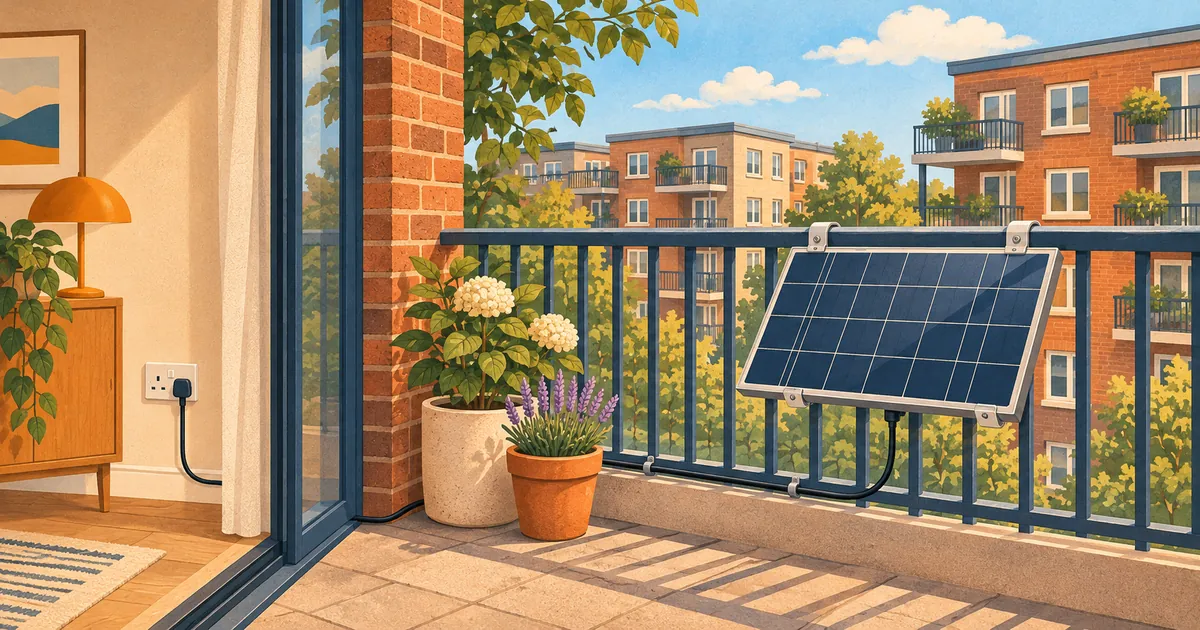
Since 27 August 2026, compliant plug-in (often called "balcony") solar has been legal in Great Britain. The regulations allow devices with a maximum rated AC output of 800 W that meet the government's product specification. Permission from a landlord or freeholder may still be needed. For flats and rented homes, the bigger question is usually who owns the roof or wall.
Plug-in solar: what changed
The regulations
The regulations, SI 2026/848, were made on 16 July 2026 and came into force on 27 August 2026. They amend the Plugs and Sockets etc. (Safety) Regulations 1994 and the Electricity Safety, Quality and Continuity Regulations 2002. The key points from the text:
- A device must have "a maximum rated alternating current output not exceeding 800 watts".
- It must comply with the "Plug-in Solar Device Interim Product Specification, version 2, published by the Secretary of State on 16 July 2026."
- It must not be designed to take electricity from the home to store for later supply, apart from control or auxiliary functions allowed by that specification.
- The change to the electricity safety regulations "extends to England and Wales and Scotland". It does not extend to Northern Ireland, so the position there is different.
GOV.UK's June 2026 announcement said the changes would "allow UK homeowners to self-install plug-in solar panels in the coming months".
The official limits
The government's Plug-in Solar Device Interim Product Specification, version 2 (PDF) controls the product and connection requirements. Read together with the regulations, it says:
- Output: maximum rated AC output is 800 W under the legislation. The IPS also caps maximum apparent power at 800 VA and current at 3.5 A. Panel DC capacity may be higher, up to 2,000 W, but above 960 W of panel capacity the maker must advise considering a professional assessment of the existing electrical installation.
- No battery system: the legislation excludes a device designed to import household electricity for storage. The IPS does not cover plug-in battery systems or plug-in solar integrated with a battery, and requires a prominent warning that the device is not intended to be connected to, operated with or used with battery energy storage.
- One device: the IPS permits one plug-in solar product per final circuit. However, it also says the GB network rule in G98 restricts this to one device per household unless and until that rule is amended. The government's July 2026 response says the same. Use the one-per-household limit unless official current guidance confirms that G98 has changed.
- Direct connection only: use the manufacturer-supplied standard plug in a suitable socket. Extension cables, multi-way adaptors, RCD adaptors and travel adaptors are not permitted. A manual cannot override this IPS ban.
Check that any product states compliance with IPS version 2; a generic overseas "balcony solar" kit is not automatically compliant.
Safety bodies urge caution
The Institution of Engineering and Technology issued a statement on 30 July 2026 saying consumers should "have their electrical installation assessed by a competent electrician before connecting a plug-in solar PV unit", and that "safety simply cannot depend on the layperson".
Before you connect a compliant plug-in solar device, follow the maker's manual and have a qualified electrician check your wiring and the circuit it will use. Connect it directly to a suitable socket using its supplied plug. Do not use an extension cable, multi-way adaptor, RCD adaptor or travel adaptor. Use no more than one device per household unless official current guidance confirms that G98 has changed.
Planning rules for plug-in solar in England
The same day the electrical rules changed, England's permitted development rules for home solar were rewritten by SI 2026/896. It defines plug-in solar as panels "intended for connection to the relevant domestic premises' electricity installation by means of a standard plug and socket", and the Planning Portal says the changes "clarify the potential to install 'plug-in' solar" (Planning Portal blog).
On the Planning Portal's page for solar on houses and flats, plug-in solar "should not be installed on a wooden wall, balcony or enclosure", nor on timber-clad exteriors. For freestanding equipment in a garden, the stand-alone solar page says plug-in units may not be fixed to a wooden fence, gate, wall or other enclosure. In conservation areas and World Heritage Sites, extra restrictions apply to walls and balconies that front a highway.
A compliant installation is likely permitted development — check with your council if in doubt, especially for listed buildings and conservation areas. Scotland, Wales and Northern Ireland have their own planning rules; see our planning permission guide.
Money: VAT, export and expectations
- VAT. GOV.UK's Notice 708/6 says energy-saving materials supplied "without installing them" are standard-rated, so a self-installed kit bought off the shelf will not normally get the 0% rate that installed rooftop systems do. This is general information, not financial or tax advice. Rules change, so check GOV.UK or speak to a qualified adviser.
- Export payments. Ofgem's SEG guidance for generators requires certification (such as MCS) and an export meter. Do not assume a plug-in device will earn export payments; ask your supplier.
- Output. An 800 W cap is a fraction of a typical rooftop system. Our generation guide explains how output depends on orientation and location; a vertical balcony panel will not match a well-angled roof.
Portable panels are different
Folding panels that charge a portable power station are not connected to your home wiring at all. If that is what you are considering, Ferncharge's guide to sizing a solar panel for a power station covers it.
Flats and leaseholders
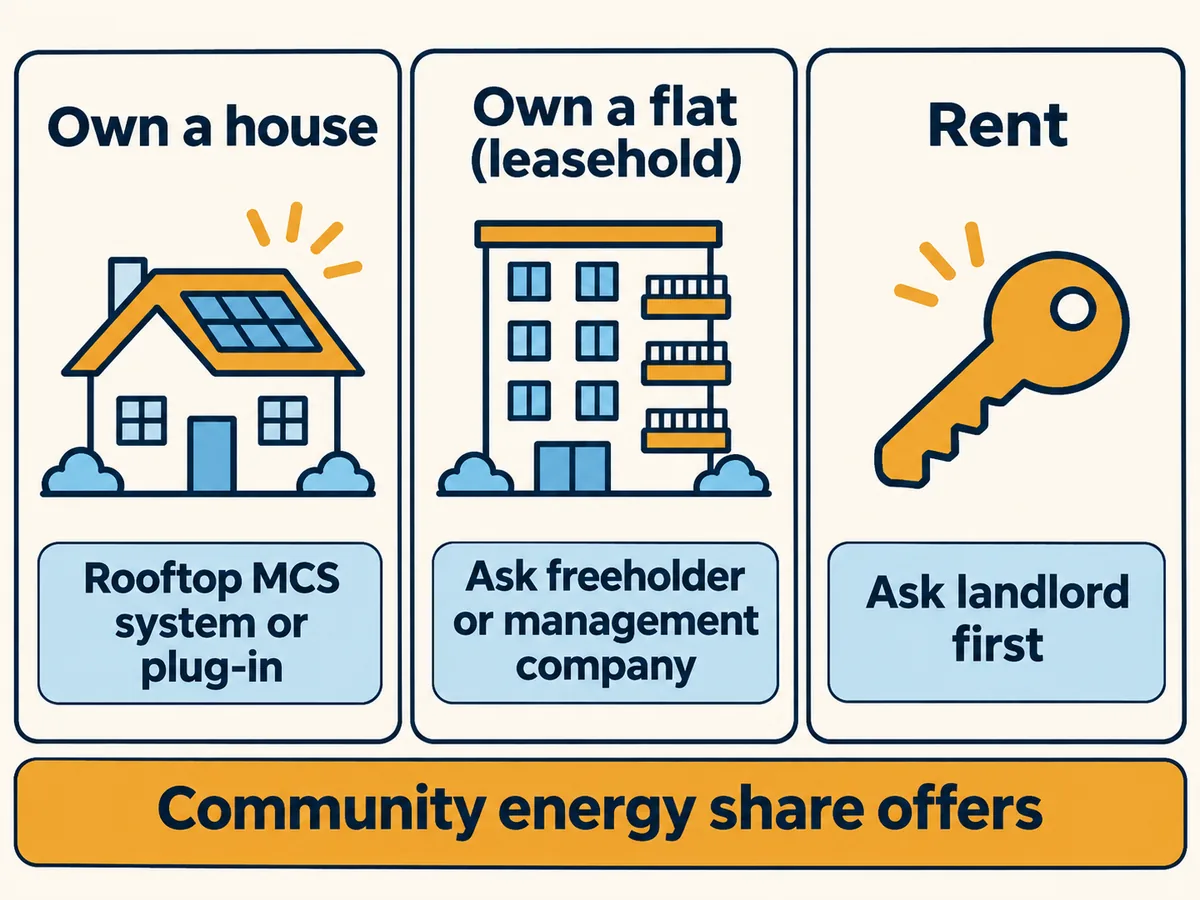
If you own a flat on a lease, the roof and external walls usually belong to the freeholder. The Planning Portal notes that leaseholders may need permission from their landlord, freeholder or management company, separately from any planning question. Read your lease and ask in writing before buying anything.
Planning rules for flats also differ from houses:
- England: since 27 August 2026, the Planning Portal sets out separate permitted development rules for blocks of flats, including a 200 mm projection limit from the wall or roof slope and the ban on timber surfaces for plug-in solar.
- Wales: the Welsh Government's solar page says its permitted development rights "apply to houses", and flat owners should contact their local planning authority.
- Scotland and Northern Ireland: check with your council; see our planning guide.
For a whole building, a shared rooftop system is a project for the freeholder or residents' management company, using an MCS-certified installer.
Renters
If you rent, ask your landlord before fitting anything, including a plug-in device on a balcony. The device, any fixings and any change to how it connects to the property's wiring can all be matters for your tenancy agreement, and the landlord remains responsible for the electrical installation. Get any agreement in writing.
Community energy: another route
If you cannot put panels on your own home, community energy groups sometimes raise money through share offers to build local renewable projects. Community Energy England lists members' share offers, but stresses that it "is neither qualified nor authorised to offer investment advice" and that "we haven't vetted or endorsed any of the opportunities shown on this page". Treat a share offer as an investment that can lose value, and read the offer documents in full.
Next steps
- Read the short answer on whether plug-in balcony solar panels are legal in the UK.
- Understand the rooftop rules in solar panel planning permission.
- If you own a house, see how many solar panels you need.
Sources
Opened and checked on 15 November 2026.
- https://www.legislation.gov.uk/uksi/2026/848/made
- https://assets.publishing.service.gov.uk/media/6a60a03c47af652afa0c89f5/plug-in-solar-final-_interim-product-specification.pdf
- https://assets.publishing.service.gov.uk/media/6a58dd1e24d4d0ad06d945e1/plug-in-solar-government-response-july-2026.pdf
- https://www.gov.uk/government/news/more-families-to-benefit-from-lower-bills-through-plug-in-panels
- https://www.theiet.org/media/press-releases/press-releases-2026/press-releases-2026-july-september/30-july-2026-updated-statement-iet-warns-governments-plug-in-solar-plans-still-leave-consumers-exposed-to-electrical-safety-risks
- https://www.planningportal.co.uk/permission/common-projects/solar-panels/planning-permission-solar-equipment-mounted-on-a-house-or-a-block-of-flats-or-on-a-building/
- https://www.planningportal.co.uk/permission/common-projects/solar-panels/planning-permission-stand-alone-solar-equipment-panels-not-on-a-building-but-within-the-grounds-of-a-house-or-a-block-of-flats/
- https://blog.planningportal.co.uk/2026/08/28/changes-to-permitted-development-rules-for-domestic-solar-installations/
- https://www.legislation.gov.uk/uksi/2026/896/made
- https://www.gov.wales/planning-permission-solar-panels
- https://www.gov.uk/guidance/vat-on-energy-saving-materials-and-heating-equipment-notice-7086
- https://www.ofgem.gov.uk/sites/default/files/docs/2020/02/seg_generator_guidance_-_final_for_publication.pdf
- https://communityenergyengland.org/share-offers/