Guides · Planning, tax and paperwork
Solar panels and planning permission in the UK (2026 rules)
Permitted development for rooftop and ground-mounted solar in England after the August 2026 changes, plus Scotland, Wales, Northern Ireland, listed buildings and conservation areas.
In England, solar panels on the roof of a house are often permitted development, which means planning permission is not needed if every condition is met. For a typical pitched-roof installation that is likely permitted development — check with your council if in doubt. The rules changed on 27 August 2026, they are stricter for listed buildings, conservation areas and flats, and Scotland, Wales and Northern Ireland have their own rules. Your installer should check them before work starts.
This guide summarises official pages checked on 15 November 2026. It is not legal advice. Your local planning authority has the final say, and you can apply for a lawful development certificate if you want certainty.
England: what changed in August 2026
The Town and Country Planning (General Permitted Development) (England) (Amendment) Order 2026 was made on 29 July 2026 and came into force on 27 August 2026. The Planning Portal blog says the changes "split the eligibility requirements into distinct rules for houses and blocks of flats" and "clarify the potential to install 'plug-in' solar".
The Planning Portal page on solar equipment on a building also notes that "a 12-month transitional period has been added, ending on 27 August 2027". Projects already planned under the old rules should be checked against that transition.
England: panels on the roof of a house
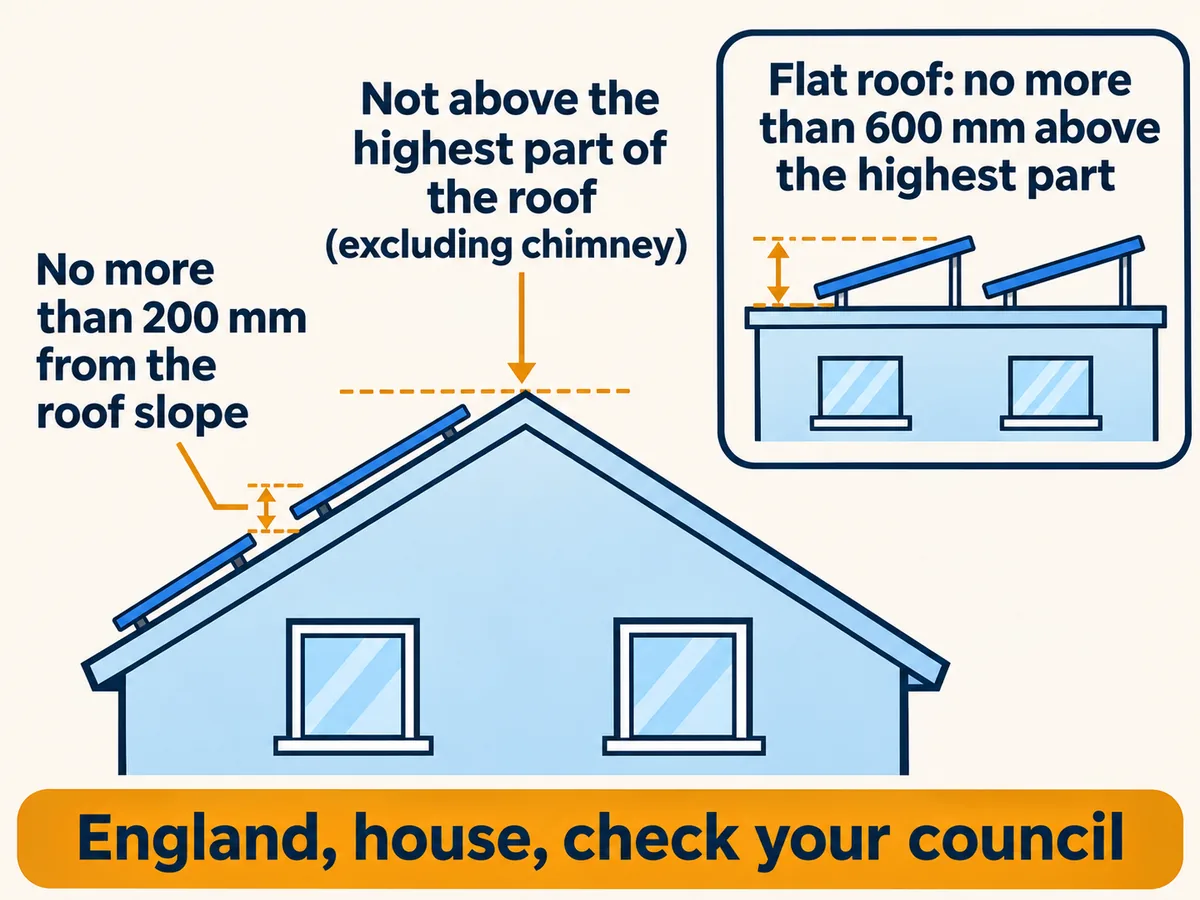
According to the Planning Portal, the main limits for a house after the change are:
- Pitched roofs: panels "should project no more than 200mm from the roof slope", and "should not be installed above the highest part of the roof (excluding the chimney)".
- Flat roofs: panels "cannot be more than 600mm higher than the highest part of the roof (excluding chimney)". On Article 2(3) land, which includes conservation areas, a flat-roof installation needs an application to the council for prior approval.
- Walls: where a wall faces a highway, equipment "should not protrude more than 0.2 metres beyond the plane of the wall"; elsewhere "it should not protrude by more than 0.4 metres".
- Appearance: equipment should be "sited, so far as is practicable, to minimise the effect on the external appearance of the building", and removed when no longer needed.
Conservation areas and World Heritage Sites
In these areas, the Planning Portal says nothing may go on a wall, balcony or roof enclosure that fronts a highway. Rooftop panels may still be possible, but this is exactly where you should ask the council first.
Listed buildings
Permitted development does not apply to listed buildings. The Planning Portal says panels "must not be installed on a building that is within the grounds of a listed building", and scheduled monument sites are excluded too. You will need to apply, and listed building consent is likely to be needed as well. Talk to your council's conservation officer early.
England: ground-mounted panels
The Planning Portal page on stand-alone solar sets these limits for houses after the change:
- maximum area of 9 square metres
- height no more than 1 metre if within 5 metres of the boundary and in front of the house, 2 metres if within 5 metres of the boundary, 2 metres in a conservation area if nearer the highway than the house, and otherwise 4 metres
- prior approval needed on Article 2(3) land within 5 metres of the boundary
For blocks of flats, the older limits still apply, including permission for only the first stand-alone installation.
England: flats and plug-in solar
Blocks of flats now have their own rules, which the Planning Portal says are "largely the same as before", including the 200 mm projection limit, plus a ban on fixing equipment to timber. Leaseholders "may need" permission from their landlord, freeholder or management company even where planning rules allow the work.
Plug-in solar is now covered too. The Planning Portal says it "should not be installed on a wooden wall, balcony or enclosure", or on timber-clad exteriors. For electrical rules and who can use it, see our plug-in solar, flats and renters guide.
Scotland
Scotland's rules are set out in Planning Circular 1/2024. For panels on a house, development is not permitted if panels "would protrude more than 1 metre from the outer surface of an external wall", with related limits for roofs, ridge and chimney. In conservation areas, development "is permitted provided the solar panels and equipment are mounted on a rear elevation" or a side elevation that does not front a road. On listed buildings, "development is not permitted on a listed building or within the curtilage of a listed building", nor within a World Heritage Site. Check with your council in Scotland before you commit.
Wales
The Welsh Government says panels "should not be installed above the ridgeline", with a 200 mm projection limit. On flat roofs, panels must not be "sited within 1 metre of the external edge of the roof" or "protrude more than 1 metre above the plane of the roof". For listed buildings, "installation will require planning permission". In conservation areas and World Heritage Sites, consent is required for panels on principal or side elevation walls visible from the highway. Wales notes that "these permitted development rights apply to houses", so flat owners should contact their local planning authority. Stand-alone panels are limited to one installation of no more than 9 m².
Northern Ireland
In Northern Ireland, the Planning (General Permitted Development) Order (Northern Ireland) 2015, as originally made, says roof panels are not permitted development if they "protrude more than 20 centimetres beyond the plane of any existing roof slope" that faces and is visible from a road, or more than "1.5 metres above the plane of any flat roof". Stand-alone panels are limited to one installation of no more than 14 m² and 2 metres high. Later amendments may have changed this, so check with your council before relying on it.
Building regulations are separate
Planning is only half the story. The Planning Portal says "the ability of the existing roof to carry the load (weight) of the panel will need to be checked and proven", that "some strengthening work may be needed", and that building regulations "also apply to other aspects of the work such as electrical installation". It recommends an installer "preferably one who belongs to the Competent Person Scheme", who can self-certify the work. Wales uses the same roof-load wording.
A simple checklist
- Is the building listed, or in the grounds of a listed building? If so, apply.
- Is it in a conservation area or World Heritage Site? Check wall and frontage rules, and prior approval for flat roofs.
- Is it a house or a flat? The rules differ.
- Do the panels stay within 200 mm of a pitched roof and below the highest point?
- Which nation are you in? Use that nation's rules.
- If in doubt, ask the council or apply for a lawful development certificate.
Next steps
- Read about MCS, DNO notification and VAT.
- Find out how to choose an installer who will handle the checks.
- Short answers to common questions are in the knowledge base.
Sources
Opened and checked on 15 November 2026.
- https://www.planningportal.co.uk/permission/common-projects/solar-panels/planning-permission-solar-equipment-mounted-on-a-house-or-a-block-of-flats-or-on-a-building/
- https://www.planningportal.co.uk/permission/common-projects/solar-panels/planning-permission-stand-alone-solar-equipment-panels-not-on-a-building-but-within-the-grounds-of-a-house-or-a-block-of-flats/
- https://www.legislation.gov.uk/uksi/2026/896/made
- https://blog.planningportal.co.uk/2026/08/28/changes-to-permitted-development-rules-for-domestic-solar-installations/
- https://www.gov.scot/publications/circular-1-2024-householder-permitted-development-rights/pages/6/
- https://www.gov.wales/planning-permission-solar-panels
- https://legislation.gov.uk/nisr/2015/70/schedule/part/2/made?view=plain
- https://www.planningportal.co.uk/permission/common-projects/solar-panels/building-regulations/
- https://www.gov.wales/building-regulations-solar-panels