Tool
Solar sizing and savings estimator
Estimate a sensible solar PV system size, panel count, annual generation, self-use versus export, indicative savings and a simple payback range for a UK home. Indicative only.
Indicative only. This estimator uses regional averages and simple assumptions. It cannot see your roof, shading, wiring or tariff details. Before you spend money, get a written quote and site survey from an MCS-certified installer, whose generation estimate follows the MCS method.
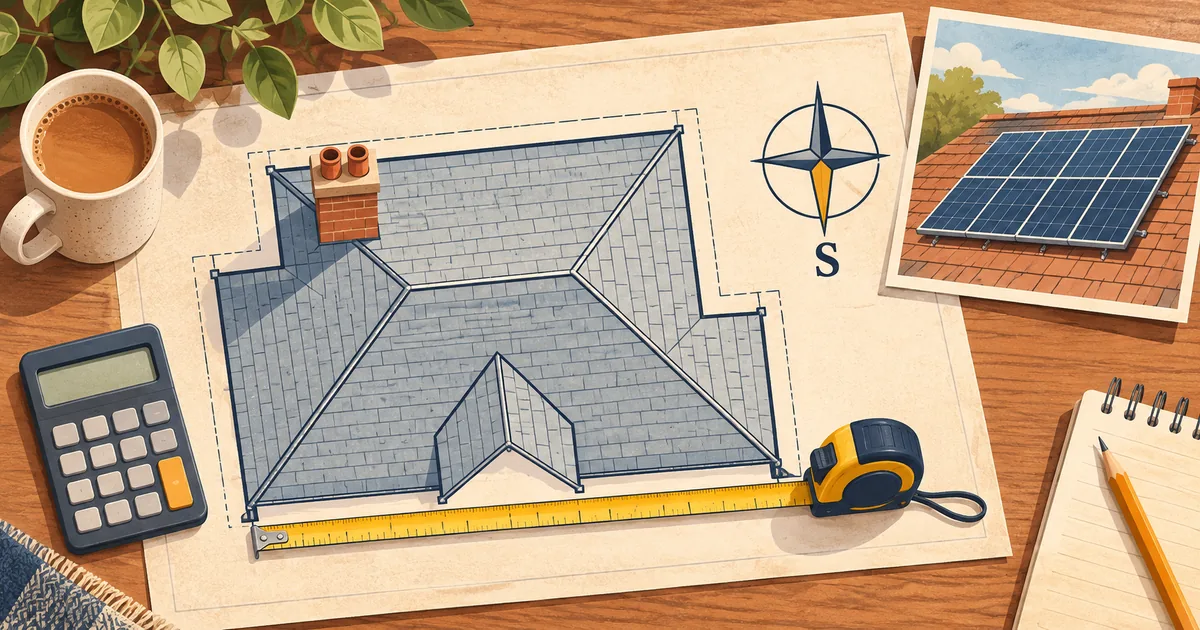
How it works, in plain words (this explanation works without JavaScript): we divide your usable roof area by the area of a typical panel to get a panel count, multiply by the panel power to get a size in kWp, and cap it at what your electricity use reasonably justifies if you ask us to. Generation is size × the regional yield for a south-facing roof at about 35° (from PVGIS) × an orientation factor × a shading factor. Self-use is your daytime share of use, limited by what the panels generate. The rest is exported. Savings are self-use × your import price plus export × your export rate. Payback is a range: the installed-cost band divided by annual savings.
The figures behind the estimator
Defaults
Regional yield (kWh per kWp per year)
Annual output of a 1 kWp system facing due south at a 35° tilt with 14% system losses, from the EU Joint Research Centre's PVGIS calculator (PVGIS-SARAH3 data), queried on 15 November 2026 for one location in each region.
| Region | Location queried | kWh/kWp/year |
|---|---|---|
| London and South East England | London | 1019 |
| South West England | Plymouth | 1118 |
| East of England | Norwich | 1030 |
| Wales | Cardiff | 1042 |
| Midlands | Birmingham | 968 |
| North West England | Manchester | 886 |
| North East England and Yorkshire | Newcastle | 949 |
| Central and southern Scotland | Glasgow | 859 |
| Northern and north-east Scotland | Aberdeen | 887 |
| Northern Ireland | Belfast | 919 |
Orientation factors
Output relative to due south at 35°, from PVGIS runs for London on the same date with the same settings. Other locations differ a little.
| Orientation (35° tilt) | Share of south-facing output |
|---|---|
| South | 100% |
| South-east | 95% |
| South-west | 93% |
| Split east and west | 79% |
| East | 80% |
| West | 77% |
| North-east | 62% |
| North-west | 60% |
| North (not recommended) | 53% |
What this does not include
- Panel degradation over time, inverter replacement, maintenance, or changes in energy prices.
- Time-of-use tariffs, battery charging from cheap night-time electricity, or EV charging patterns.
- Your real roof: obstacles, fire-access margins, the roof's structure and the DNO's limit on export.
The battery option uses a simple assumption stated in the result: it raises self-use towards the share an installer might estimate, it does not model a specific battery. Read whether a solar battery is worth it for the method in full.
Next: how many solar panels you need, what solar panels cost and export rates compared.