Guides · Costs and savings
Are solar panels worth it in the UK? The honest maths for 2026
How to judge whether solar PV pays off for your home, using Energy Saving Trust savings and payback figures, current prices and a method you can repeat.
For most UK homes with a reasonably sunny, unshaded roof, solar panels do pay for themselves within their working life, but how quickly depends on where you live, how much electricity you use while the sun is up, and what you are paid for the rest. The Energy Saving Trust puts typical payback for a home system at roughly 9 to 12 years with export payments, against panels that it says "should last 25 years or more". That is a reasonable bet, not a guaranteed one, and the inputs are worth checking for your own house.
What the Energy Saving Trust figures say
The Energy Saving Trust (EST) publishes indicative yearly savings for a typical home system. Its main solar page says "domestic solar panel systems are around 4.5 kWp and cost around £7,600" (checked 15 November 2026). Its savings chart, published through Infogram, gives these figures in pounds a year:
| Location | Home all day | Home half the day | Out all day |
|---|---|---|---|
| London, with export payments | 930 | 920 | 900 |
| London, without export payments | 330 | 270 | 200 |
| Manchester, with export payments | 810 | 800 | 740 |
| Aberystwyth, with export payments | 870 | 870 | 840 |
| Stirling, with export payments | 740 | 720 | 680 |
EST says the figures are "indicative for a four bedroom detached property in the UK, based on fuel prices as of July 2026 (GB, gas-heated)". Its payback estimates with export payments are 9 years in London, 10 to 11 in Manchester, 9 to 10 in Aberystwyth and 11 to 12 in Stirling.
Two things stand out. First, being paid for exported electricity matters a great deal: without export payments, savings in the chart fall to a third or less. Second, being home in the day matters less than many people expect once export is paid, because the electricity you do not use still earns something.
Why your answer may differ
EST's figures are a starting point. Your own payback depends on five things.
- Installed cost. EST's £7,600 is one figure. MCS says the average cost of a certified home system in 2025 was "just over £7,000". Government Solar PV cost data for 2025/26 puts the median for 0 to 4 kW installations at about £1,780 per kW on its long-running basis (checked 15 November 2026). Scaffolding, roof shape and extras such as optimisers or a battery move the price up.
- Generation. A south-facing roof in Plymouth produces noticeably more than the same roof in Glasgow. Our generation guide explains the regional and orientation differences.
- How much you use yourself. Each unit you use instead of buying saves the full import price. At the Ofgem price cap for 1 October to 31 December 2026, that is 26.32p per kWh on average for Direct Debit customers in Great Britain.
- What you are paid for export. EST says you will typically get "around 12p for every unit that you don't use yourself" through the Smart Export Guarantee. Rates vary widely between suppliers; see our export rates comparison.
- Future prices. Nobody knows them. Higher electricity prices shorten payback; lower ones lengthen it.
Ofgem notes that "there is no VAT on electricity from 1 October 2026 to 31 March 2027", so unit prices cannot be compared directly with earlier periods. If VAT returns, the value of each unit you avoid buying rises too. Check the latest cap before relying on any savings figure.
The method: work out your own payback
You can repeat the calculation with a pencil, or let the estimator do it.
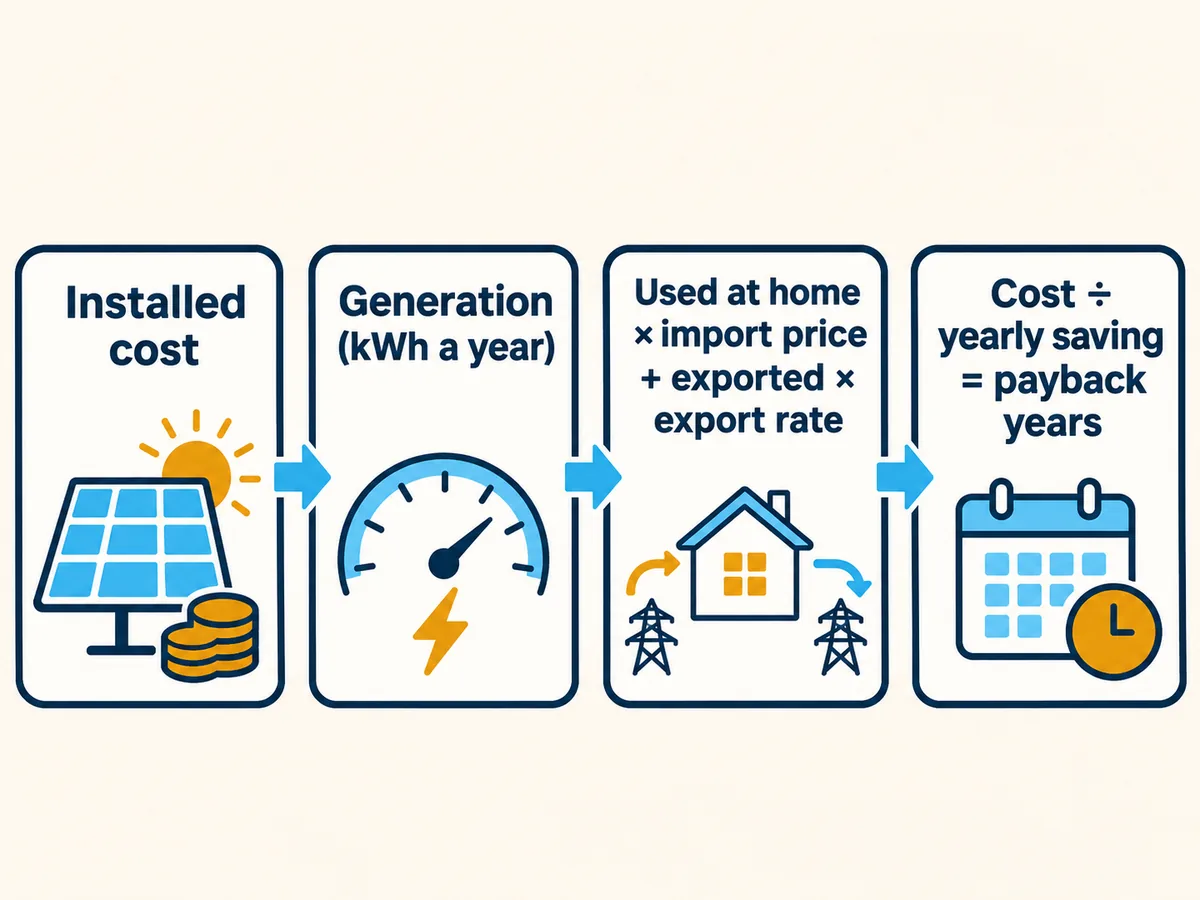
- Estimate generation. System size in kWp × a yield figure for your area and roof. MCS installers use the formula "Annual AC output (kWh) = kWp x Kk x SF" from MIS 3002, where Kk depends on postcode zone, pitch and orientation and SF is a shade factor.
- Split it. Decide what share you will use at home. Someone at home with daytime appliances uses more; a household that is out all day exports more.
- Value it. Self-used kWh × import price, plus exported kWh × export rate.
- Divide. Installed cost ÷ yearly saving = simple payback in years.
As an illustration only, using round numbers rather than a quote: a system producing 3,500 kWh a year, with 1,200 kWh used at home at 26.32p and 2,300 kWh exported at 12p, would save about £316 plus £276, roughly £590 a year. At £7,000 installed, that is about 12 years. Change any input and the answer moves, which is exactly why a survey matters.
Try the numbers for your own roof: the solar sizing and savings estimator turns roof area, orientation, region and electricity use into a kWp range, a generation estimate and an indicative payback range, with every default sourced.
Costs people forget
- Inverter replacement. EST says "if you have a solar inverter, you need to replace this after around 12 years". Budget for one replacement over the panels' life.
- Scaffolding and access. Usually in the quote, but check.
- Maintenance. Light. Rain cleans panels tilted at 15 degrees or more, according to EST.
- Bird proofing. Sometimes offered as an extra; see our maintenance guide.
Things that make solar more worthwhile
- An unshaded roof facing south, south-east or south-west.
- Daytime electricity use, such as working from home, an electric vehicle charged in daylight, or a hot water diverter.
- A good export tariff. Several suppliers pay more to their own import customers.
- Planning to stay in the home for a decade or more.
- Installing while the 0% VAT rate applies. GOV.UK says the zero rate on installing energy-saving materials such as solar panels in homes runs until 31 March 2027, after which it reverts to 5%. This is general information, not financial or tax advice. Rules change, so check GOV.UK or speak to a qualified adviser.
Things that make it less worthwhile
- A north-facing roof. EST says it does not recommend panels on one.
- Heavy shading from trees, chimneys or nearby buildings.
- A roof that needs replacing soon. Removing and refitting panels adds cost.
- Very low electricity use with no plan to increase it.
- Being unable to get an export tariff, for example without a smart meter that records export.
Is solar popular?
It is growing fast. Government statistics say that by the end of September 2026 there were 2,160,000 solar installations in the UK, and that in September 2026 alone 19,449 new schemes were installed on residential buildings. Popularity is not proof it suits your roof, but it does mean there is a large installer market to get competing quotes from.
Next steps
- See current cost bands in our solar panel cost guide.
- Compare export tariffs, because they change the answer more than anything else.
- Decide whether a battery is worth adding.
- Get at least two quotes from MCS-certified installers.
Sources
Opened and checked on 15 November 2026.
- https://energysavingtrust.org.uk/advice/solar-panels/
- https://e.infogram.com/_/5BuMO8jjuxzMJTEKnATN
- https://www.ofgem.gov.uk/your-energy-supply/your-energy-bill/energy-price-cap-unit-rates-and-standing-charges
- https://mcscertified.com/consumers/technologies/solar-photovoltaic-pv/
- https://www.gov.uk/government/statistics/solar-pv-cost-data
- https://www.gov.uk/government/statistics/solar-photovoltaics-deployment
- https://octopus.energy/smart/outgoing/
- https://www.gov.uk/guidance/vat-on-energy-saving-materials-and-heating-equipment-notice-7086
- https://mcscertified.com/wp-content/uploads/2026/03/MIS-3002_Solar-PV-Systems-V6.0-Final.pdf