Guides · Costs and savings
SEG export rates compared: what suppliers pay for solar exports
Smart Export Guarantee and export tariff rates from Octopus, British Gas, EDF, E.ON Next and OVO, checked 15 November 2026, with who qualifies and how SEG works.
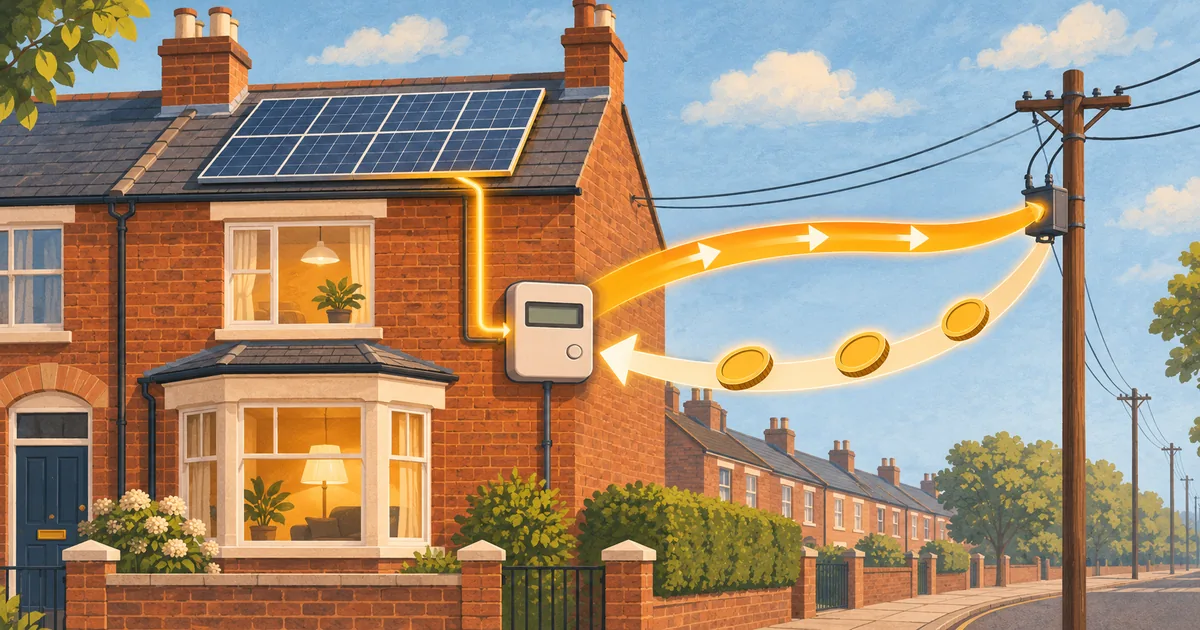
On 15 November 2026, the export tariffs we checked paid between 2p and 20p per kWh, depending on the supplier, the tariff and whether you also buy your electricity or your solar system from them. Open-to-anyone tariffs were at the low end (2p to 4p). Tariffs for a supplier's own import customers clustered around 12p to 13p, and the highest rates were for people who bought their solar or battery from that supplier.
The Energy Saving Trust's solar advice uses a similar working figure: "Typically, you'll get around 12p for every unit that you don't use yourself through the Smart Export Guarantee."
How the Smart Export Guarantee works
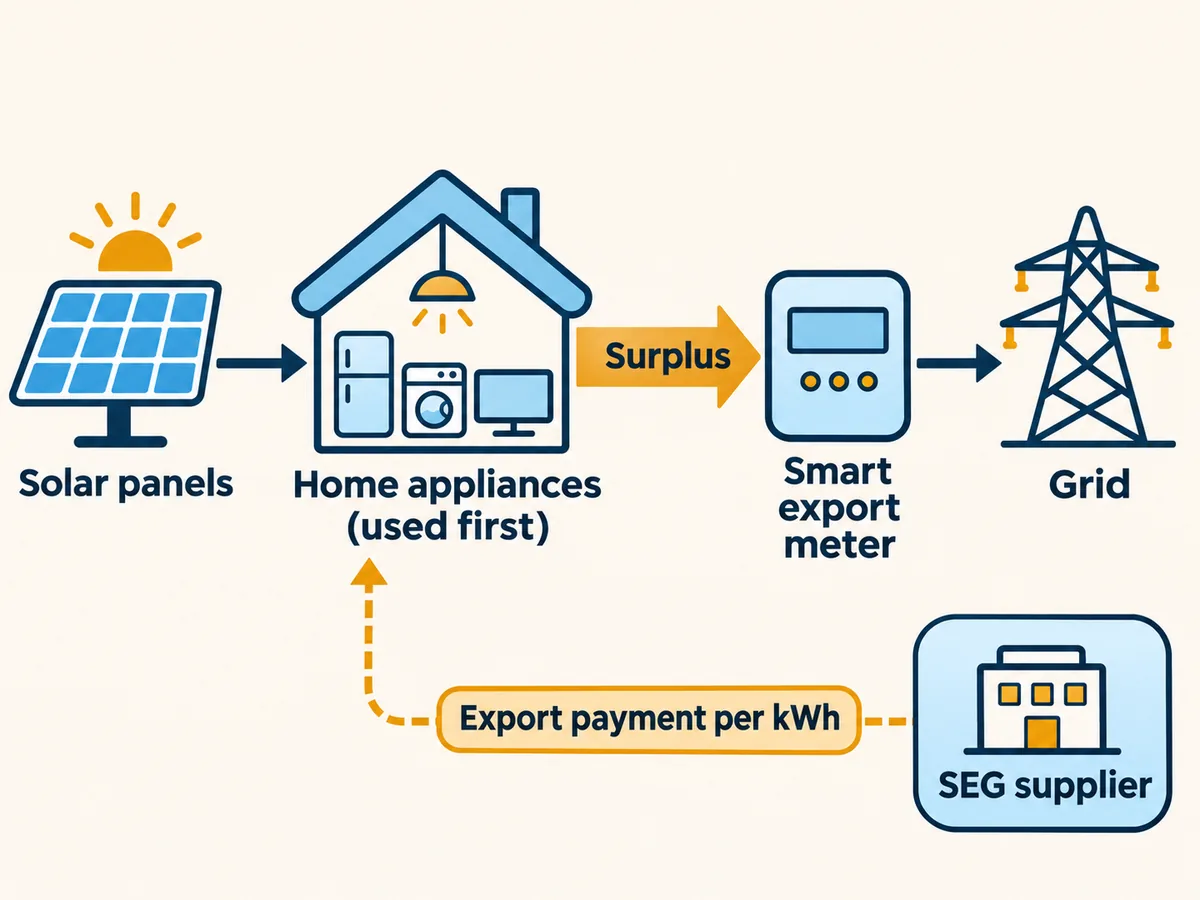
The rules are set by Ofgem. From its SEG pages, checked 15 November 2026:
- The SEG launched on 1 January 2020 and covers installations up to 5 MW (50 kW for micro-CHP) in Great Britain.
- "SEG tariff rates must always be above zero. SEG payments are calculated by using export meter readings."
- A supplier must offer a SEG tariff if it has "at least 150,000 domestic electricity customers as at 31 December of the immediately preceding year" (supplier rules). Smaller suppliers can choose to.
- "your SEG licensee does not need to be the same company as your current energy supplier" (generator page). Many of the best rates, though, are only for the supplier's own customers.
To apply you need evidence of certification, an export meter that can take half-hourly readings, and an export MPAN, according to Ofgem's guidance for generators. Ofgem allows certification by MCS or an equivalent scheme; MCS's own SEG page says you are eligible if "Your system was installed by an MCS certified installer using certified products", and suppliers may ask for the certificate. In practice, an MCS installation is the straightforward route. See MCS, DNO and VAT paperwork.
Export rates compared (checked 15 November 2026)
| Supplier | Tariff | Rate | Who can get it (as stated by the supplier) |
|---|---|---|---|
| Octopus Energy | Outgoing Octopus | 12p/kWh, variable | Octopus Energy customers |
| Octopus Energy | Prime Outgoing | 16p/kWh 4pm to 7pm; 9p/kWh rest of the day | Octopus Energy customers |
| Octopus Energy | Agile Outgoing | Half-hourly, follows day-ahead wholesale prices; no single rate shown | Octopus Energy customers |
| British Gas | Export Premium | 12p/kWh, variable (systems up to 15 kW) | British Gas electricity customers |
| British Gas | Export Extra | 8p/kWh (systems over 15 kW) | British Gas electricity customers |
| British Gas | Export SEG | 3p/kWh | Non-customers |
| EDF | Export Exclusive 12m V3 | 18p/kWh | Customers who buy solar or a battery from EDF |
| EDF | Export 12m V2 | 13p/kWh, fixed 1 year | EDF install customers |
| EDF | SEG Export Variable Value | 5.6p/kWh | EDF electricity customers |
| EDF | SEG Export Variable | 2.0p/kWh (from 28 October 2026) | Anyone |
| E.ON Next | Next Export Premium v3 | 17.5p/kWh, fixed 12 months | E.ON installs from 10 November 2025, systems up to 15 kW |
| E.ON Next | Next Export Exclusive v3 | 13p/kWh | E.ON Next import customers (not on a time-of-use tariff) |
| E.ON Next | Next Flex Export v1 | 6p/kWh, variable | All customers |
| OVO | SEG | 4p/kWh | Electricity supply with any provider |
| OVO | SEG Beyond Exclusive | 12p/kWh | OVO supply customers, systems under 30 kW |
| OVO | SEG Install Exclusive | Up to 20p/kWh (15p for an OVO-installed solar system) | OVO supply customers |
Notes:
- British Gas's page showed the rates as "Updated 27th August 2026". Its older "Export and Earn" name no longer appeared on the page.
- E.ON Next requires a smart export meter and consent for half-hourly data collection on all its export tariffs.
- ScottishPower is a mandatory SEG supplier on Ofgem's 2026–27 supplier list, but its website blocked our checks on 15 November 2026, so its rates are not shown. Check its SmartGen page directly.
- Other mandatory SEG suppliers on Ofgem's list for 1 April 2026 to 31 March 2027 include E (Gas and Electricity), Utility Warehouse (Electricity Plus Supply), Foxglove, Fuse, So Energy and Utilita. Voluntary licensees include Pozitive, Ruby, Smart Pay Energy and Voltx.
Rates change often, and "variable" tariffs can change at short notice. Always check the supplier's current page and terms before switching.
Choosing an export tariff
Look at the import tariff too. The highest export rates mostly require you to buy your electricity from the same supplier. A great export rate tied to an expensive import tariff can leave you worse off. The Ofgem price cap unit rate for 1 October to 31 December 2026 is 26.32p per kWh for electricity on Direct Debit (GB average), per Ofgem. Ofgem also notes there is no VAT on electricity from 1 October 2026 to 31 March 2027. This is general information, not financial or tax advice. Rules change, so check GOV.UK or speak to a qualified adviser.
Self-use usually beats export. Every kWh you use yourself saves the import price, roughly double a typical 12p export rate. Running the washing machine or dishwasher in daylight, or diverting surplus to a hot water cylinder, often adds more value than chasing an extra penny of export. Our sister site looks at using solar to charge a heat battery as another way to store surplus.
Time-of-export tariffs suit batteries. A tariff such as Prime Outgoing pays more from 4pm to 7pm. With a battery you can sometimes hold energy for that window. See is a solar battery worth it?
Fixed or variable. A fixed rate gives certainty for its term; a variable rate can rise or fall.
A quick worked example
Suppose your system exports 1,500 kWh a year. That is an illustrative figure; your installer's estimate will give yours. At 12p per kWh, export earns 1,500 × £0.12 = £180 a year. At 4p it earns £60, and at 2p it earns £30. The same 1,500 kWh used in the home instead would save 1,500 × £0.2632 = about £395 at the price cap unit rate. Use the sizing and savings estimator with your own rates.
Next steps
- See the full payback picture: is solar worth it in the UK?
- Check your paperwork is SEG-ready: MCS, DNO and VAT paperwork
- Find out whether storage would raise your self-use: is a solar battery worth it?
Sources
Opened and checked on 15 November 2026.
- https://www.ofgem.gov.uk/environmental-and-social-schemes/smart-export-guarantee-seg
- https://www.ofgem.gov.uk/environmental-and-social-schemes/smart-export-guarantee-seg/electricity-suppliers
- https://www.ofgem.gov.uk/environmental-and-social-schemes/smart-export-guarantee-seg/generators
- https://www.ofgem.gov.uk/guidance/smart-export-guarantee-supplier-list
- https://www.ofgem.gov.uk/sites/default/files/docs/2020/02/seg_generator_guidance_-_final_for_publication.pdf
- https://mcscertified.com/consumers/consumer-grants-incentives/smart-export-guarantee/
- https://energysavingtrust.org.uk/advice/smart-export-guarantee/
- https://energysavingtrust.org.uk/advice/solar-panels/
- https://octopus.energy/smart/outgoing/
- https://www.britishgas.co.uk/energy/smart-export-guarantee-tariff.html
- https://www.edfenergy.com/energy-efficiency/smart-export-tariff
- https://www.eonnext.com/electricity-and-gas/smart-export-guarantee
- https://www.ovoenergy.com/smart-export-guarantee
- https://www.ofgem.gov.uk/your-energy-supply/your-energy-bill/energy-price-cap-unit-rates-and-standing-charges