Guides · Sizing and generation
How many solar panels do I need? Sizing a UK home system
Work out a sensible solar system size in kWp and a panel count from your roof area, orientation, shading and electricity use, with sourced rules of thumb.
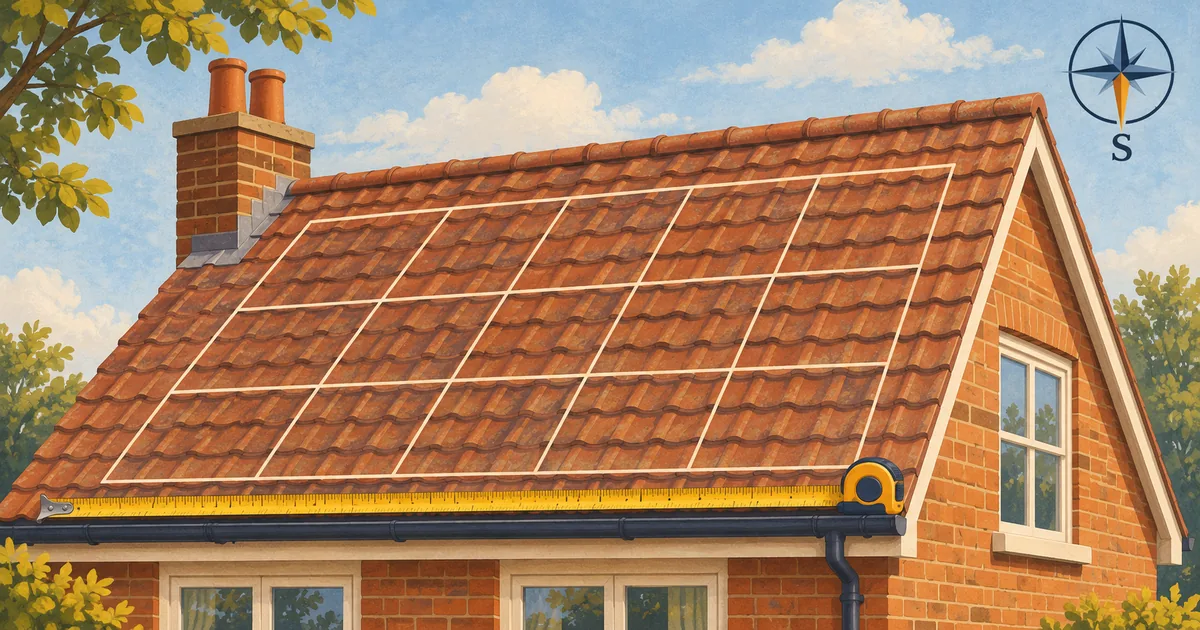
The right number of panels for your home comes from three limits: how much usable roof you have, how much electricity you use, and what your local network will accept. The Energy Saving Trust says "domestic solar panel systems are around 4.5 kWp" and that such a system "typically covers between 20 to 30m2 of roof surface area, typically using around 12 panels". Use that as a reference point, then size for your own house.
Step 1: measure the usable roof
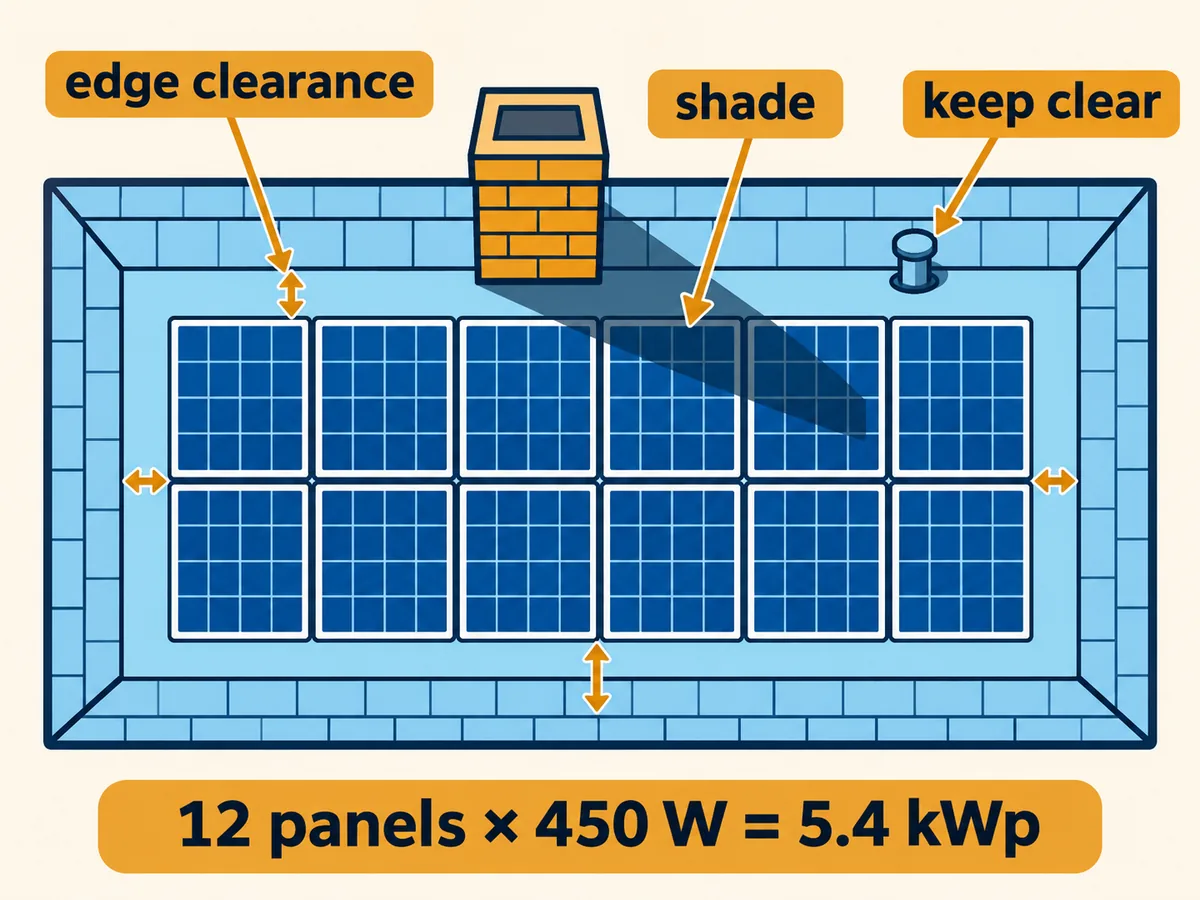
Panels need an unobstructed, reasonably regular area. Measure each roof slope you might use (length along the eaves × height up the slope) and subtract space for:
- chimneys, roof windows, vents and soil pipes
- edges, ridges and valleys, where installers leave clearance
- areas that are shaded for much of the day
A typical modern home panel is about 2 square metres. For example, the Trina Vertex S+ datasheet lists 1,762 × 1,134 mm for a 450 to 475 W panel, and the LONGi Hi-MO X10 Explorer datasheet lists 1,800 × 1,134 mm for 475 to 490 W. Both checked 15 November 2026.
Divide your usable area by about 2 m² to get a first panel count, then knock off some for awkward shapes. Our estimator assumes the realistic count could be up to 20% lower than the simple division.
Step 2: convert panels to kWp
System size is quoted in kilowatt-peak (kWp): the panels' combined rated output under standard test conditions.
kWp = number of panels × panel wattage ÷ 1,000
| Panels | At 430 W | At 450 W | At 480 W |
|---|---|---|---|
| 8 | 3.44 kWp | 3.60 kWp | 3.84 kWp |
| 10 | 4.30 kWp | 4.50 kWp | 4.80 kWp |
| 12 | 5.16 kWp | 5.40 kWp | 5.76 kWp |
| 14 | 6.02 kWp | 6.30 kWp | 6.72 kWp |
Higher-wattage panels fit more kWp on the same roof but are usually physically a little larger, so check dimensions as well as watts.
Step 3: check orientation and shading
Orientation decides how hard each kWp works. EST says "an unshaded, south-facing roof is ideal" and that "a system facing east or west tends to get around 15-20% less energy than one facing directly south". The EU Joint Research Centre's PVGIS model, which we queried for London on 15 November 2026 at a 35° pitch, gives:
| Roof faces | Output compared with south |
|---|---|
| South | 100% |
| South-east | 95% |
| South-west | 93% |
| East | 80% |
| West | 77% |
| North | 53% |
EST does "not recommend installing panels on a north facing roof". An east and west split can still work well, because it spreads generation across the morning and evening.
Shading matters more than people think, because panels are wired together. EST explains that optimisers mean "if one panel is shaded, it doesn't impact how much electricity the other panels can generate", but adds that "if your roof doesn't have shading, optimisers won't help". An MCS installer must assess shading using the method in MIS 3002, which applies a shade factor to the generation estimate.
Step 4: match the size to your electricity use
Fill the roof, or size for your use? It depends on your export rate and budget.
- Look at your bills. Your annual electricity use in kWh is on your annual statement or supplier app.
- Estimate yield. Each kWp produces roughly 860 to 1,120 kWh a year on a south-facing roof, depending on region, according to our PVGIS checks. See the generation guide.
- Compare. A system whose yearly generation is close to your yearly use is a common target. Generating more than you use is fine if you are paid a decent export rate; see export rates compared.
- Plan for change. An electric car or a heat pump raises use. Sizing up now can be cheaper than adding panels later.
As a worked example only: a household using 3,500 kWh a year in the Midlands, where PVGIS gives about 968 kWh per kWp for a south-facing roof, would match its use with about 3.6 kWp, or eight 450 W panels. On an east-facing roof at 80% of that yield, it would need about 4.5 kWp, or ten panels.
Try the numbers for your own roof: the solar sizing and savings estimator turns roof area, orientation, region and electricity use into a kWp range, a generation estimate and an indicative payback range, with every default sourced.
Step 5: the network and the inverter
Larger systems need more paperwork. Network operators explain that the simpler G98 route applies to generation "up to 16 amps per phase (Single phase systems up to 3.68kW and Three phase systems up to 11.04kW)", according to Electricity North West. "Anything larger will fall into a G99 application." National Grid says under G98 "you must notify us of the generation installation within 28 days of commissioning".
The 3.68 kW limit relates to the inverter's output rather than panel kWp, so many homes pair a slightly larger panel array with a 3.68 kW inverter. Your installer will handle the application and explain any limit. Our MCS, DNO and VAT guide covers the detail.
Step 6: check the roof itself
Before choosing a size, make sure the roof can take it. The Planning Portal says "the ability of the existing roof to carry the load (weight) of the panel will need to be checked and proven" and that "some strengthening work may be needed". If the roof covering is near the end of its life, replace it before the panels go on.
Quick reference
| Usable roof area | Rough panel count (2 m² panels) | Rough size at 450 W |
|---|---|---|
| 12 m² | 5 to 6 | 2.3 to 2.7 kWp |
| 20 m² | 8 to 10 | 3.6 to 4.5 kWp |
| 25 m² | 10 to 12 | 4.5 to 5.4 kWp |
| 30 m² | 12 to 15 | 5.4 to 6.8 kWp |
These ranges are our arithmetic from the panel sizes above, not survey results.
Next steps
- Try your own roof in the sizing estimator.
- See what that size might generate where you live.
- Check typical installed costs.
- Get two or three quotes from MCS-certified installers, who will survey the roof properly.
Sources
Opened and checked on 15 November 2026.
- https://energysavingtrust.org.uk/advice/solar-panels/
- https://www-cdn.trinasolar.com/wwwstorage/sites/7/eu-260224-datasheet-vertex-s-neg9r.28-en-2026-a-web-260224-datasheet-vertex-s-neg9r.28-en-2026-a-web.pdf
- https://static.longi.com/Hi_MO_X10_Explorer_LR_7_54_HVH_475_490_M_30_30_and_15_Frame_e909d07793.pdf
- https://joint-research-centre.ec.europa.eu/photovoltaic-geographical-information-system-pvgis_en
- https://mcscertified.com/wp-content/uploads/2026/03/MIS-3002_Solar-PV-Systems-V6.0-Final.pdf
- https://connections.nationalgrid.co.uk/get-connected/solar-and-wind/micro-generation-single-g98
- https://www.enwl.co.uk/get-connected/apply-for-a-new-connection/generation-and-storage/micro-generation-and-storage-connections/
- https://www.planningportal.co.uk/permission/common-projects/solar-panels/building-regulations/