Guides · Panels, inverters and batteries
Is a solar battery worth it? How to size one and do the sums
How to size a home battery for solar panels, what the Energy Saving Trust says batteries cost, and a step-by-step method to judge whether one pays for itself.

A battery stores solar electricity you would otherwise export, so you can use it in the evening instead of buying from the grid. Whether that is worth it comes down to one sum: how many kilowatt hours the battery moves each year, multiplied by the gap between what you pay for electricity and what you are paid to export it, compared with what the battery costs over its life. This guide shows how to do that sum with your own numbers rather than relying on a salesperson's payback claim.
What batteries cost
The Energy Saving Trust gives these bands (checked 15 November 2026):
- On its battery storage page: costs "can range from £1,500 to £10,000, but the cost for a 5kWh battery system is around £4,600".
- On its main solar panels page: "battery storage tends to cost around £5,000 to £8,000".
The battery page also says "a typical home system might be 10 kWh" and that the "typical lifespan of a battery is about 10 to 12 years". Lifespan matters as much as price: a battery that has not paid for itself before it wears out has cost you money.
Black Friday and other sale prices can change at short notice through about 1 December. Treat any retailer checkout price as current only when you open it; do not assume a merchant's promotion ends on a particular date unless its own terms say so.
On VAT, GOV.UK's Notice 708/6 says the zero rate covers electrical storage batteries installed in homes from 1 February 2024, including "the retrofitting of a battery" to an existing solar system, until 31 March 2027. This is general information, not financial or tax advice. Rules change, so check GOV.UK or speak to a qualified adviser.
How a battery creates value
Without a battery, solar electricity you do not use at the time it is generated is exported. With a battery, some of that surplus is stored and used later, so you buy less from the grid.
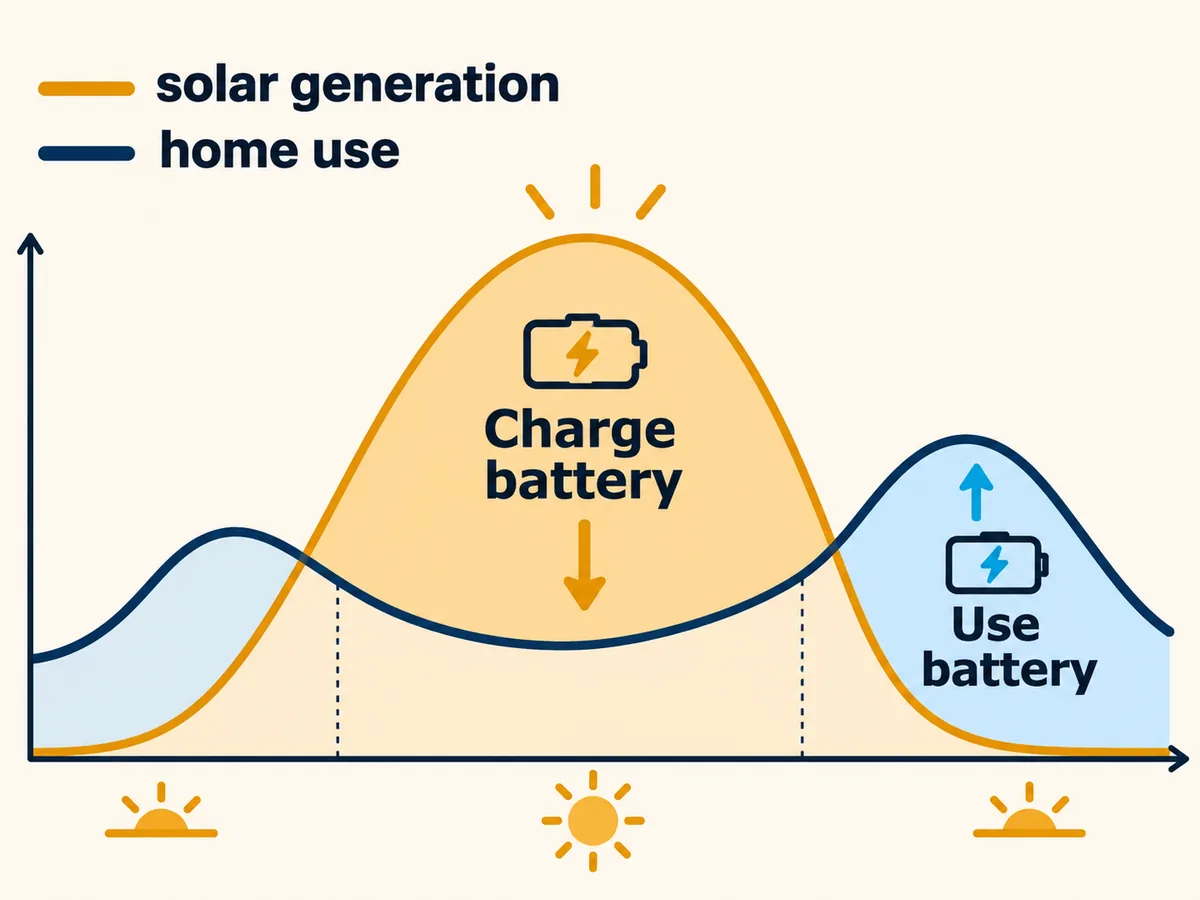
Each kWh moved this way is worth roughly:
import price − export rate
At the Ofgem price cap for 1 October to 31 December 2026, the GB average electricity unit rate on Direct Debit is 26.32p per kWh (Ofgem, checked 15 November 2026). Octopus's Outgoing Octopus export tariff pays 12p per kWh to its customers (Octopus, checked 15 November 2026). With those two figures, each kWh shifted is worth about 26.32 − 12 = 14.32p. Your own figures will differ, so use your tariff.
The higher your export rate, the less a battery adds. If you are paid a high export rate, exporting may be nearly as good as storing.
The method: five steps
Step 1: find your evening use
The battery can only replace electricity you would otherwise buy when the panels are not generating enough, mostly evenings and nights. Look at your smart meter data or supplier app for half-hourly use, or measure it (see the energy monitor section below). Note roughly how many kWh you use from late afternoon to bedtime.
Step 2: estimate your daily surplus
Your MCS installer's quote should include a self-consumption estimate. Generation minus self-use is your export. Divide by 365 for a rough daily average, but remember winter surplus is much smaller than summer surplus.
Step 3: the battery moves the smallest of three numbers
On a given day, the energy a battery can shift is limited by whichever is smallest:
- its usable capacity (not the headline "nominal" figure),
- your surplus solar that day,
- your evening use that the battery can cover.
So oversizing the battery beyond your evening use or your typical surplus adds cost without adding savings.
Step 4: annual value
Add up a realistic year (some installers model this for you) to get kWh shifted per year. Then:
annual value = kWh shifted per year × (import price − export rate)
Step 5: compare with the cost over its life
simple payback (years) = installed battery cost ÷ annual value
Compare that with the expected life and warranty. If the payback is longer than the warranty, or longer than the 10 to 12 years the Energy Saving Trust gives as typical, the battery is unlikely to pay for itself on solar shifting alone.
An illustration of the arithmetic, using round made-up numbers. Suppose a battery shifts 1,000 kWh a year and each kWh is worth 14.32p. Annual value = 1,000 × £0.1432 = £143.20. If the battery cost £4,600, simple payback = 4,600 ÷ 143.20 ≈ 32 years. That 1,000 kWh is an assumption to show the method, not an estimate for your home. Put in your own figures.
Other reasons people buy a battery
The sum above only covers storing solar. Some households value other things, which you should price separately rather than blending into one hopeful payback number:
- Time-of-use tariffs. Some tariffs have cheaper night-time rates, so a battery can charge from the grid overnight and discharge at peak times. The value is (peak price − cheap price) per kWh, minus losses. Check the exact tariff terms.
- Peak export tariffs. Octopus's Prime Outgoing pays 16p per kWh from 4pm to 7pm and 9p the rest of the day (Octopus, checked 15 November 2026). A battery could shift export into that window. Check your supplier's conditions.
- Backup in a power cut. Many systems switch off in a grid outage for safety. Backup needs specific hardware and wiring; ask the installer whether your system will provide it, and for which circuits.
Sizing: usable capacity and power
Two numbers on a battery datasheet matter most:
- Usable capacity (kWh): how much energy you can actually draw. For example, Enphase lists its IQ Battery 5P at 5.0 kWh (Enphase UK store). GivEnergy describes its All in One 2 as having "13.5 kWh capacity" but the page we opened does not say whether that is usable (GivEnergy). Ask your installer for the usable figure.
- Power (kW): how fast it can charge or discharge. A low power rating may not cover a kettle and oven at the same time, so the rest comes from the grid.
Our best solar batteries guide compares published specs for several home batteries.
Measure before you buy: energy monitors
Most people do not know their evening use. Your smart meter app may show it. If not, a monitor can help you gather a few weeks of data before you size a battery.
- A clamp-type meter such as the Shelly EM Gen3 listed on Amazon UK or the newer Shelly EM Gen4 listed on Amazon UK measures whole-house or circuit use with a current clamp; the listings describe a single-phase, 2-channel meter with a 50A CT clamp included.
- A plug-in monitor such as the Tapo P110M smart plug listed on Amazon UK measures a single appliance plugged into it, which is useful for checking big evening loads one at a time.
Fitting a current clamp means working inside or next to your consumer unit. Unless you are competent and the maker's manual allows it, ask a qualified electrician to fit it. Plug-in monitors need no wiring but must stay within their rated current.
When a battery is more likely to make sense
- You export a lot in summer and use a lot in the evening.
- Your export rate is low compared with your import price.
- You are on, or will switch to, a time-of-use tariff and understand its terms.
- You are adding panels anyway, so installation costs are shared.
When it is less likely to make sense
- You are at home in the day and already use most of your generation.
- You have a high export rate.
- The quote is for a battery much larger than your evening use.
Next steps
- Compare published specs in best solar batteries for UK homes.
- See what suppliers pay for export in SEG export rates compared.
- Try a battery on or off in the sizing and savings estimator.
- Read can I add a battery later?
Sources
Opened and checked on 15 November 2026.
- https://energysavingtrust.org.uk/advice/solar-panel-battery-storage/
- https://energysavingtrust.org.uk/advice/solar-panels/
- https://www.ofgem.gov.uk/your-energy-supply/your-energy-bill/energy-price-cap-unit-rates-and-standing-charges
- https://octopus.energy/smart/outgoing/
- https://www.gov.uk/guidance/vat-on-energy-saving-materials-and-heating-equipment-notice-7086
- https://givenergy.com/hardware/all-in-one-2/
- https://enphase.com/en-gb/store/storage/iq-battery-5p-flexphase