Guides · Planning, tax and paperwork
MCS, DNO and VAT: the paperwork behind a home solar install
What the MCS certificate, G98 or G99 grid notification and 0% VAT mean for a UK home solar system, and which documents to keep.

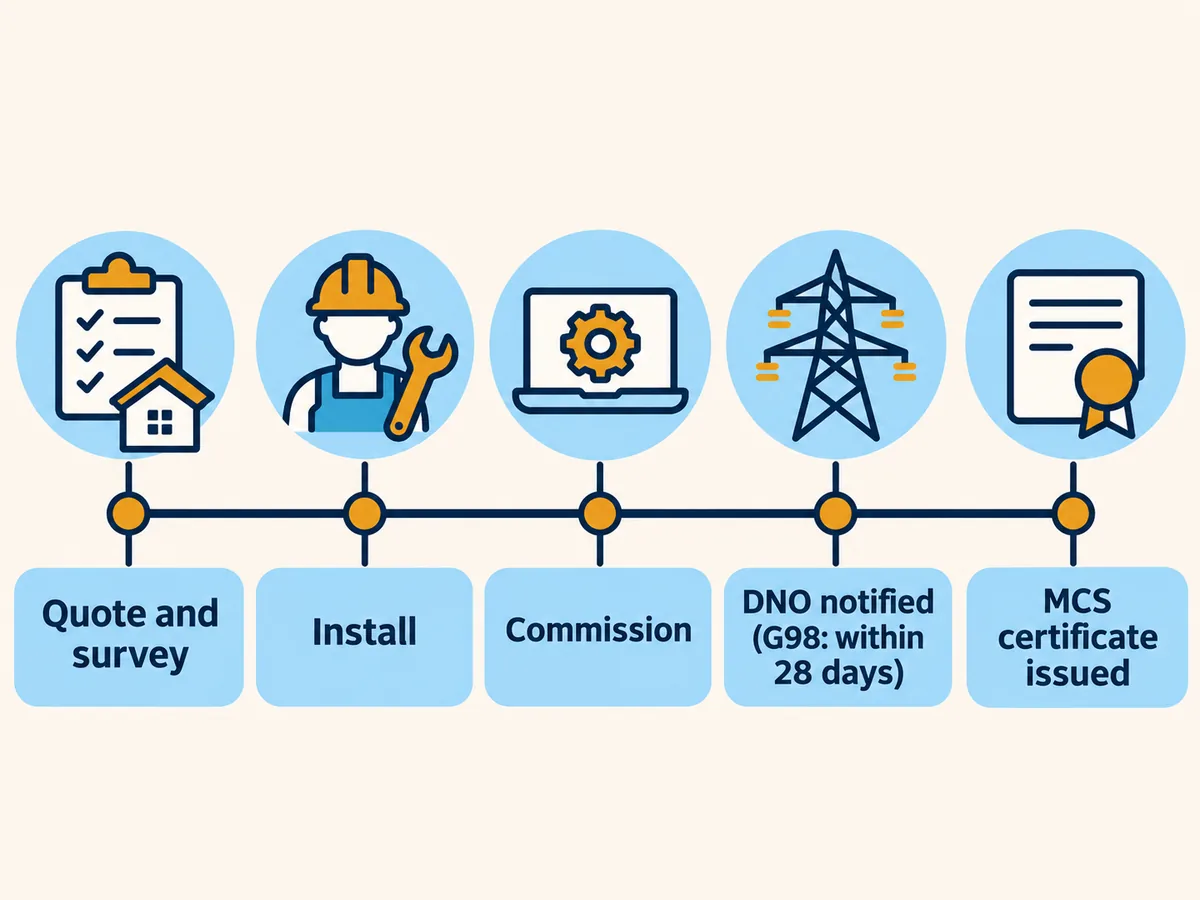
A typical home solar installation comes with three bits of paperwork that matter long after the scaffolding has gone: the MCS certificate, the notification to your local electricity network operator (G98 or G99), and an invoice showing the right VAT treatment. Your installer normally handles all three, but it is worth knowing what each one is, because you will need them for export payments, for selling the house and for any warranty claim.
The MCS certificate
MCS describes itself as "the UK's quality mark for small-scale renewable energy technologies" on its home page. An MCS-certified installer has been assessed against the scheme's standards, and the products they fit are certified too.
According to MCS's page on certificate queries, the certificate is "a record that your installation has been designed and installed to industry-recognised standards". The installer issues it, and MCS says this happens "within 14 days of the system being commissioned" (the same page mentions 30 days under its redeveloped scheme). If the installer is no longer certified or trading, MCS can issue a replacement for a fee of £36 (as listed on that page, checked 15 November 2026).
Why it matters for export payments
The Smart Export Guarantee (SEG) is how most households get paid for electricity they send to the grid. MCS's SEG page says you are eligible if your system "was installed by an MCS certified installer using certified products", and that suppliers "might ask for your MCS certificate".
Ofgem's guidance for SEG generators says applicants must show certification, which "may be a Microgeneration Certification Scheme (MCS) certificate", and must "have an export meter" with an export MPAN. More broadly, MCS notes on why certification matters that it "is also a requirement for accessing many UK government incentives".
In practice: if an installer is not MCS certified, ask how you would claim export payments before you sign. You can check any firm on the MCS installer search. Our export rates comparison shows what suppliers pay.
Telling the network operator: G98 and G99
Every solar inverter that connects to the grid has to be declared to the distribution network operator (DNO) for your area. Which process applies depends on the size of the inverter output, not the number of panels.
G98: smaller systems, notify after
National Grid's G98 page says "the rated output must be under 16A per phase for connection at low voltage" and "you must notify us of the generation installation within 28 days of commissioning". Electricity North West puts that in kilowatts: G98 "applies to all generation installations up to 16 amps per phase (Single phase systems up to 3.68kW and Three phase systems up to 11.04kW)".
Most single-phase homes with a modest system fall under G98. The installer fills in the form with their details and yours.
G99: larger systems, apply first
Electricity North West says "anything larger will fall into a G99 application". This is a fuller application, and the network operator may ask questions about your supply or limit how much you can export. We could not confirm the exact wording on timing from an official source today, so ask your installer and your DNO how long the G99 process takes in your area before you fix an installation date. A battery or hybrid inverter can change which process applies, so make sure the whole system is declared.
Northern Ireland
In Northern Ireland the network operator is NIE Networks. Its micro-scale generation page says the installer "will advise you which applies and typically they will make the required application on your behalf", and that "your installer has 30 days from the date of commissioning".
Ask for proof. Some suppliers ask for evidence of the grid notification before they will start export payments. Ask the installer for a copy of the G98 notification or G99 approval for your records.
VAT on solar panels and batteries
GOV.UK's VAT Notice 708/6 says: "A zero rate applies to the installation of certain specified energy-saving materials from 1 May 2023 to 31 March 2027." It adds that "from 1 April 2027 onwards these will revert to the reduced rate of VAT of 5%."
Points from the notice that homeowners ask about:
- What counts: solar panels installed in or on the site of a building, including the cabling, controls and inverter.
- Batteries: from 1 February 2024, electrical storage batteries installed in residential accommodation are covered. That includes "the retrofitting of a battery for storing electricity generated by one or more of the microgeneration systems" and a standalone battery charged from the grid.
- Installation matters: "if you supply energy-saving materials without installing them your supply will be standard-rated." Buying panels to fit yourself does not get the zero rate.
- Where: residential accommodation includes houses, flats and caravans used as permanent homes. The notice records that the zero rate has applied in Northern Ireland from 1 May 2023 as well.
So a quote dated now for a home installation should normally show VAT at 0%, and if the work finishes after 31 March 2027 the rate would change to 5% under the notice as written. Check the dates on your contract if an installation is planned for spring 2027.
This is general information, not financial or tax advice. Rules change, so check GOV.UK or speak to a qualified adviser.
Building regulations and electrical sign-off
Solar panels on a roof add weight. The Planning Portal's building regulations page for solar panels says "the ability of the existing roof to carry the load (weight) of the panel will need to be checked and proven", that "some strengthening work may be needed", and that building regulations "also apply to other aspects of the work such as electrical installation". It recommends an installer "preferably one who belongs to the Competent Person Scheme", because a registered competent person can self-certify the work instead of you applying to building control.
Planning permission is a separate question: see our planning permission guide.
The paperwork checklist
Keep these together, ideally as paper and as scans:
- The signed contract and quote, with the system size, panel and inverter models and the price including VAT.
- The MCS certificate and the installer's MCS number.
- A copy of the G98 notification or G99 approval.
- The building regulations compliance certificate (from the competent person scheme) and the electrical installation certificate.
- Product warranties for panels, inverter and any battery, plus any insurance-backed workmanship warranty and deposit protection documents.
- The installer's handover pack, including the generation estimate and the inverter's commissioning details.
- Your export tariff agreement and the export MPAN.
Buyers' solicitors often ask for several of these when you sell, and your export supplier may ask for the MCS certificate and grid notification when you apply.
Next steps
- Check an installer's credentials and consumer code before you sign: choosing a solar installer.
- Compare what suppliers pay for exported electricity: SEG export rates compared.
- Read the short answers on whether you need to tell your DNO and VAT on solar panels.
- Look up terms such as G98 and MCS in the glossary.
Sources
Opened and checked on 15 November 2026.
- https://mcscertified.com/
- https://mcscertified.com/consumers/why-mcs-certification-matters/
- https://mcscertified.com/consumers/mcs-certificate-queries/
- https://mcscertified.com/consumers/consumer-grants-incentives/smart-export-guarantee/
- https://mcscertified.com/find-an-installer/
- https://www.ofgem.gov.uk/sites/default/files/docs/2020/02/seg_generator_guidance_-_final_for_publication.pdf
- https://connections.nationalgrid.co.uk/get-connected/solar-and-wind/micro-generation-single-g98
- https://www.enwl.co.uk/get-connected/apply-for-a-new-connection/generation-and-storage/micro-generation-and-storage-connections/
- https://www.nienetworks.co.uk/connections/generation-connections/micro-scale
- https://www.gov.uk/guidance/vat-on-energy-saving-materials-and-heating-equipment-notice-7086
- https://www.planningportal.co.uk/permission/common-projects/solar-panels/building-regulations/