Guides · Living with solar
Solar panel maintenance: cleaning, bird proofing and roof checks
How often UK solar panels need cleaning, how to do it safely, when bird proofing makes sense, what the law says about nests, and what to check on the roof.
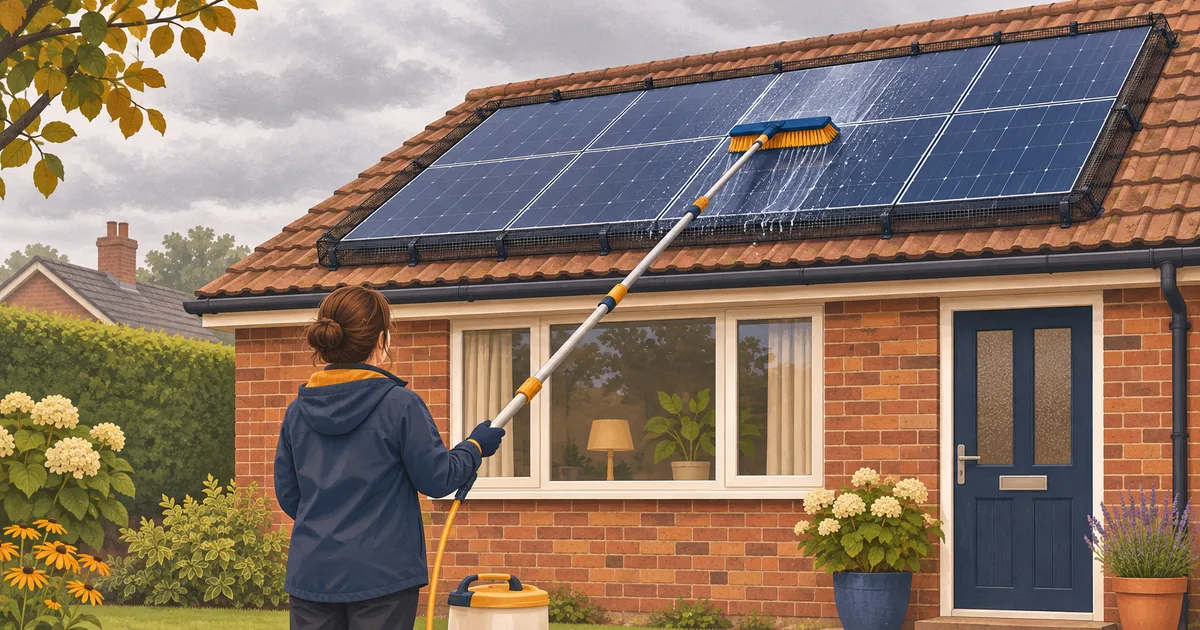
Solar panels need very little routine maintenance. The Energy Saving Trust says "in most cases, rain does a good job of keeping solar panels clean, meaning routine cleaning isn't essential", and suggests checking them every 12 to 18 months and cleaning if there is visible dirt. The two jobs homeowners most often face are occasional cleaning and keeping pigeons out from under the panels. Both involve a roof, so safety comes first.
How often to clean
From the Energy Saving Trust's cleaning and maintenance page:
- "A light clean every 12 to 24 months can help your system operate at its best by removing dirt, dust and other build-up that may reduce performance."
- "Rooftop solar panels are often kept relatively clean by rainfall because of their angle." The main EST solar page adds that in the UK rain will clean panels "if they're tilted at 15 degrees or more".
- "Homes near busy roads, farmland or other dusty environments may need more frequent cleaning", and "ground-mounted panels may collect more dirt".
A good habit is to compare your generation month by month with the same month last year in your inverter app. A steady drop that weather does not explain is a reason to look, whether the cause is dirt, a fault or shading from a growing tree.
How to clean safely
The Energy Saving Trust's advice, in short:
- Stay on the ground if you can. "If you can, clean your solar panels from the ground." It warns: "It's always safer to avoid working at heights if you don't have the right training or equipment."
- Use plain water and a soft brush. "A garden hose and soft brush are usually all that's required." If water is not enough, "check the manufacturer's guidance or ask your installer for advice before using any cleaning products."
- No pressure washers. "You should avoid using a high-pressure power washer to clean your solar panels."
- Never stand on panels. "You shouldn't stand on solar panels when you're cleaning them."
- Pick a cool time. Clean "early in the morning before the panels have heated up" or on a cooler, overcast day, because hot panels make water evaporate quickly and leave streaks.
If you are "struggling or straining to reach", the EST suggests using a professional, and says "professional solar panel cleaning costs typically start at around £60 to £100 for a standard system", more for larger or hard-to-reach arrays (checked 15 November 2026).
Ground-level cleaning kits
Long water-fed poles with a soft brush let you reach a low roof from the ground. Two examples listed on Amazon UK:
- Solar panel cleaning kit with extension pole and water-fed rotary brush, described in the listing as having a 50 cm telescoping brush head.
- Water-fed rotating solar panel brush and telescopic wand, which the listing says comes with a 25 m hose.
Check the reach you need before buying, keep clear of overhead power lines, and follow your panel maker's cleaning instructions, which take priority over any kit's claims. Some panel warranties set conditions on cleaning methods.
Do not climb onto a roof or lean a ladder against the array. Solar panels produce electricity whenever there is daylight, and the DC wiring cannot simply be switched off at the consumer unit. Leave anything beyond a ground-level rinse to your installer or a specialist cleaner.
Pigeons and bird proofing
The gap between a pitched roof and the panels is sheltered and warm, which can make it attractive to pigeons. Droppings, nesting material and noise are the usual complaints, and debris can build up around cables and fixings.
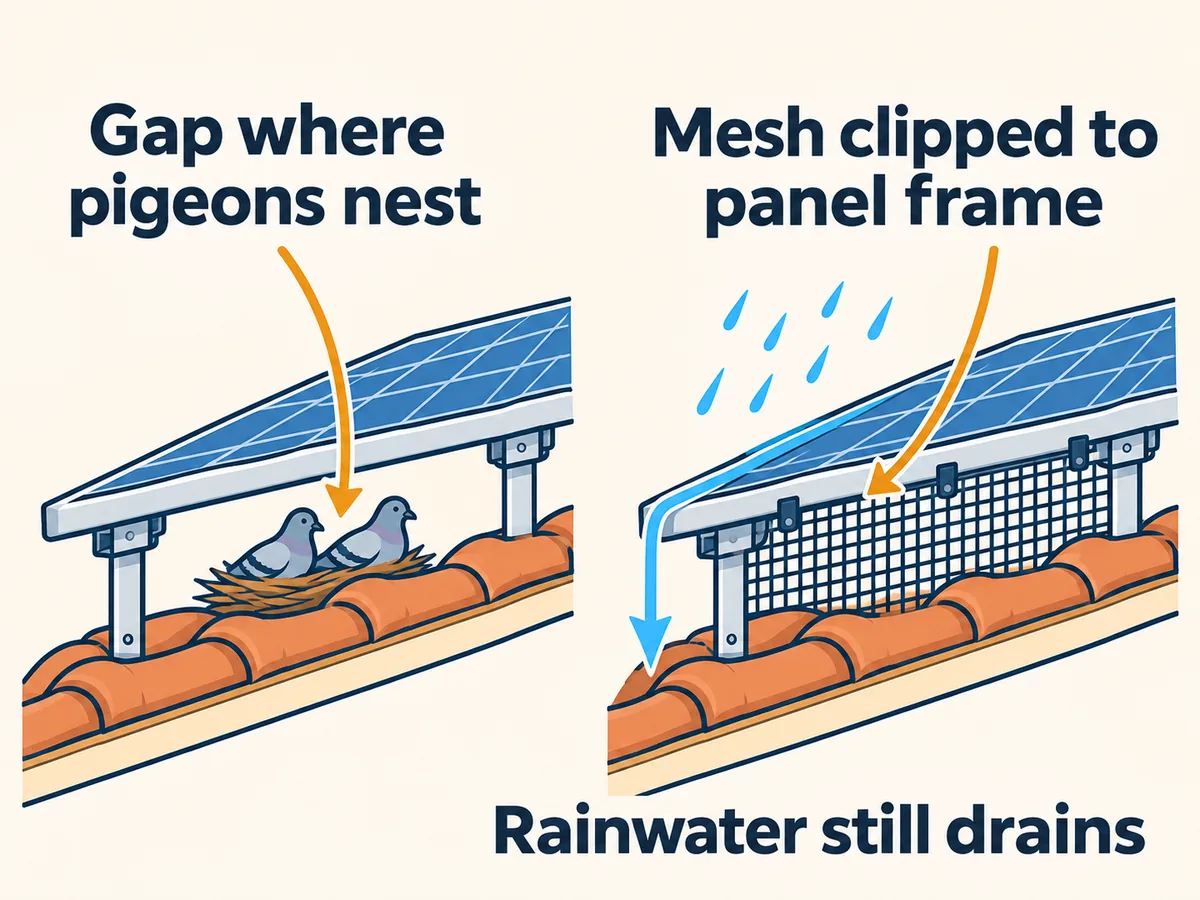
The common fix is a mesh skirt clipped to the edge of the panel frames, closing the gap without drilling into the panels. Many installers offer it as an option at installation, when the scaffolding is already up, which is usually the cheapest moment to do it. Ask for it to be itemised on your quote so you can compare.
The law on nests
GOV.UK's wild birds guidance is clear: "All wild bird species, their eggs and nests are protected by law." It is an offence to "intentionally take, damage or destroy a wild bird's nest while it's being used or built". The same page lists "taking actions to prevent problems, eg shooting birds or removing nests" among activities that can harm birds, particularly in the breeding season.
In practice, that means bird proofing should go on before birds nest or after any nest is no longer in use. If birds are nesting under your panels now, do not block them in or remove the nest; ask a specialist who knows the rules about timing. The GOV.UK page is guidance for England; check the equivalent rules if you live elsewhere in the UK.
Mesh kits
Mesh kits for solar panels are widely sold. Two examples listed on Amazon UK:
- Bird proofing mesh and 60 fixing clip kit, a 30 m black PVC roll according to the listing.
- PG solar panel bird proofing mesh kit with 60 fixing clips, also a 30 m black PVC roll according to the listing.
Buying a kit does not make the job a DIY one. Fitting mesh means working at height around live DC equipment, and clips must not damage cables, panel frames or seals. Check with your installer first: unapproved fixings could affect your warranty. For most homes, the sensible route is to buy nothing and ask your installer or a bird-proofing specialist to quote.
Roof and system checks
- Roof condition before you install. The Planning Portal says the roof's ability to carry the panels "will need to be checked and proven" and "some strengthening work may be needed" (building regulations page). If tiles, felt or flashing are near the end of their life, repair them first: removing and refitting panels later costs extra.
- Visual checks. The EST suggests looking for "wear and tear, damage, water ingress, dirt build-up, bird droppings or lichen growth" and arranging repairs if anything is wrong.
- Inverter. Check its display or app for error messages from time to time. The EST notes an inverter typically needs replacing after around 12 years, sooner than the panels themselves.
- Warranty conditions. The EST says "some installers require a full service within a specific period to keep the warranty valid". Read your handover pack and keep records of any service.
Beware unsolicited "health checks"
A Which? investigation found cold callers selling solar "health checks" and claiming annual checks are a government requirement; Which? says "this is not true". If your system needs attention, contact your original installer or another MCS-certified firm you have chosen yourself. Our installer guide covers the warning signs.
Next steps
- Track output against expectations with how much solar panels generate in the UK.
- Find a reputable firm: choosing a solar installer.
- Read the short answer on whether solar panels need cleaning.
Sources
Opened and checked on 15 November 2026.
- https://energysavingtrust.org.uk/solar-panel-cleaning-maintenance/
- https://energysavingtrust.org.uk/advice/solar-panels/
- https://www.gov.uk/guidance/wild-birds-protection-surveys-and-licences
- https://www.planningportal.co.uk/permission/common-projects/solar-panels/building-regulations/
- https://www.which.co.uk/news/article/beware-these-solar-panel-cold-calls-aH0fP6b22eOc